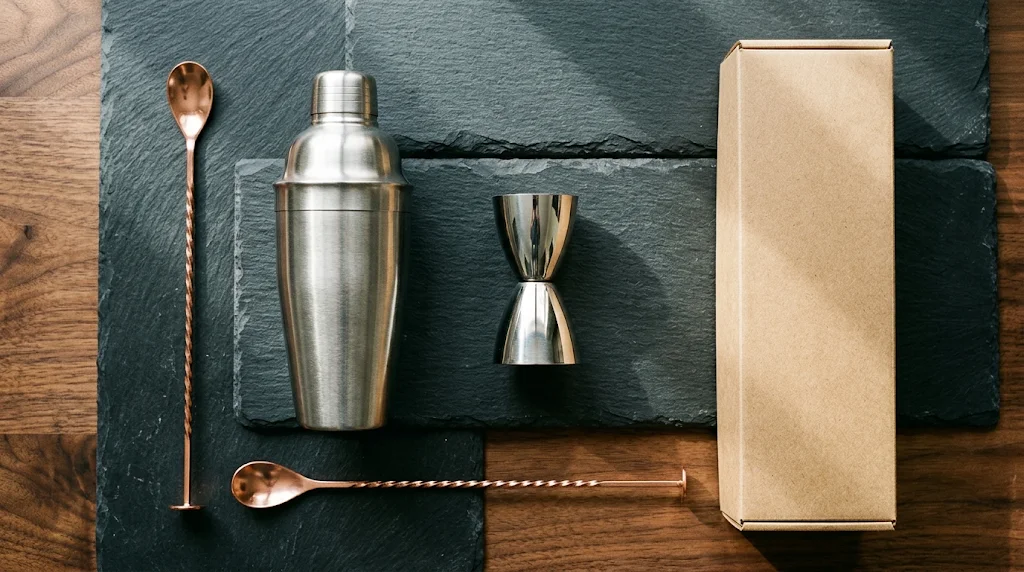
Custom barware has no single flat price list because every quote combines per-unit production variables with one-time setup charges. You cannot judge a custom barware quote by the bottom-line unit price alone; to control costs and compare suppliers fairly, you must lock in identical specifications for steel grade, finish process, logo setup, packaging, and shipping terms, and ask suppliers to itemize one-time tooling and setup fees separately from the unit price.
When two quotes for the same shaker or jigger look far apart, the usual reason: they do not price the exact same product. The tolerance range, the material weight, the plating method or the billing of fixed setup fees may differ without either sheet saying so.
What Makes Up a Custom Barware Quote: Base Body and Material
A custom barware unit price starts with the base body, the steel, and whether the project uses existing tooling or a new mold.
On existing models we customize logo, surface finish, plating color and packaging from an OEM minimum of 100 pcs; a new mold for a custom shape starts at the same 100 pcs, and we accept smaller runs as well. Below that quantity the freight and mold fees spread across fewer units and there is no volume discount, so the unit price climbs; a new mold or a special material makes a small run noticeably more expensive. As Shopify's guide to minimum order quantities explains, suppliers set MOQs to cover fixed costs that do not scale down for small orders, such as tooling, machine setup and per-run labor, and may also set minimums per color and size. To keep initial costs down, buyers can start with a small trial order and add custom options or new tooling on reorders.
When we prepare a quote at E-BON, tooling fees appear as their own block, separate from the unit price and the order quantity. If the same model is quoted at a different wall thickness or piece weight, that value appears as its own line item. Base material shifts the baseline cost too, so confirm 304 vs. 201 stainless steel before comparing any finish prices.
Surface Finishes and Plating: Where Quotes Quietly Diverge
Surface finishes and plating drive the unit price through the surface area of the piece and the specific coating technology you specify.
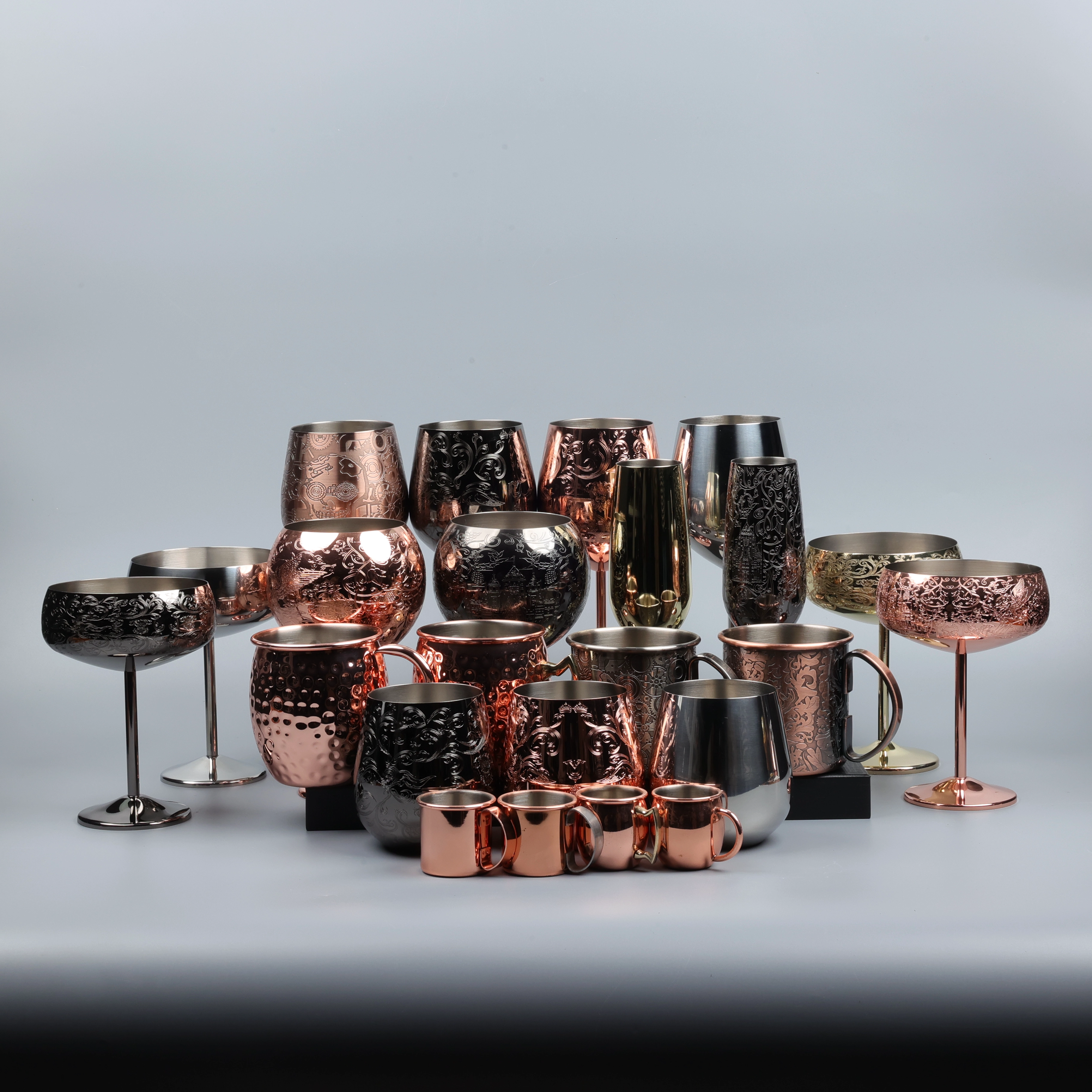
Across our barware catalog, buyers can specify mechanical finishes and color treatments in several categories:
- Surface textures: mirror polish, brushed finish, and textured patterns
- Color and pattern treatments: copper, gold, rose gold, color coating, and etched patterns
For plated colors such as gold, copper, or black, we price the plating by the surface area of the item. What we generally run for plated barware is standard wet electroplating. Physical vapor deposition (PVD) costs more and fewer buyers choose it, though we quote both. A request for a "gold shaker" or "copper jigger" does not tell a factory which process to price, so two suppliers may quote different methods unless you lock down the finish specification. Our guide to specifying stainless steel surface finishes and plating covers the technical distinctions to put on your RFQ.
Logo Application and One-Time Setup Fees
Logo techniques affect your quote twice: the per-piece application cost, and the one-time setup fee to prepare the equipment.
We offer five main logo categories across our range, confirmed by model:
- Laser engraving
- Etching
- Stamping
- Silkscreen printing
- Embossing and debossing
According to Crestline's breakdown of promotional product setup charges, a setup charge covers preparing the equipment needed to apply your artwork plus the labor to get the logo right. For screen printing, that fee covers making the stencil or silkscreen; because one- or two-color printing requires a separate screen for each color, adding colors beyond the first can add setup fees, while the setup fee for laser engraving may be higher than other printing methods.
On our quotes, mold fees are itemized separately rather than folded into the unit price, and we do not charge the mold fee again on reorders when the artwork and molds remain unchanged. Whichever method you choose, ask each supplier to show the setup charge on its own line; our guide to choosing the right logo method for custom barware compares the five.
Packaging Tiers and Printing Plates
Packaging choices change both the per-unit material cost of the box and the upfront printing setup required to put your branding on it.
We supply four main packaging options for custom barware orders:
- Standard white boxes
- Custom color boxes
- Presentation gift boxes
- Amazon FBA packaging
Once a plain box becomes a printed color box or gift box, the printing method matters as much as the box structure. As Packwire's comparison of digital and offset packaging printing notes, offset printing uses metal plates where each design requires a custom printing plate, making plate setup the most expensive part of the job, whereas digital printing requires no custom plates or setup fees and is the better choice for small runs. Because one-time setup fees weigh heavily on small quantities, the guide to why one-time costs weigh more on a small order helps you match the printing method to your order size.
How to Compare Two Barware Quotes Apples-to-Apples
In my experience reviewing quotes that land far apart, the inquiry usually left room for each factory to assume its own default specifications, or one supplier amortized fixed fees into the unit price while the other listed them separately. The omission I see most often is the tolerance range: a tighter dimensional or weight tolerance changes production yield and inspection work, so two quotes cannot be compared until both suppliers price the same tolerance range alongside the same wall thickness and piece weight.
Before comparing bottom-line numbers, align every quote against this checklist:
| Cost driver |
What to specify |
What to confirm on every quote |
| Base model or new mold |
Existing catalog item or custom 3D drawing |
Whether tooling is required and itemized as a separate block |
| Steel grade |
Exact stainless steel grade for body and small parts |
That all quotes price the same steel grade and compliance verified by third-party testing |
| Wall thickness / weight |
Target thickness in mm or piece weight in grams |
That wall thickness or weight is shown as its own line item on the quote |
| Tolerance range |
Acceptable dimensional and weight tolerance range |
That both factories are quoting the exact same tolerance standard |
| Finish and plating process |
Mechanical finish (mirror, brushed, textured) and color method |
Surface area pricing and whether the color quote is for standard wet electroplating or higher-cost PVD |
| Logo method and setup |
Laser, etching, stamping, silkscreen (with color count), or embossing/debossing |
Whether mold and setup fees are listed separately or amortized into the unit price |
| Packaging |
White box, color box, gift box, or Amazon FBA |
Box structure and whether custom printing plates are included or priced separately |
| Trade terms |
Incoterm and named port or place |
Whether the price is FOB Shenzhen (our standard quote term), EXW, or a delivered price |
For a product-specific example, see comparing quotes for private label hip flasks. Once you narrow your quotes down and order samples, verify those physical specs against our pre-production sample checklist before approving mass production.
What to Send Us for an Accurate Custom Barware Quote
A complete specification sheet in your first email gets you a line-by-line quote you can benchmark directly. Include:
- Target item or drawing: Our catalog model number for existing tooling, or your 2D/3D technical drawings if you need a new mold.
- Order quantity: Total quantity broken down by SKU, finish color, and size; tell us if you need a trial run below 100 pcs.
- Material, weight, and tolerance range: Steel grade, target wall thickness or gram weight per piece, and your required tolerance range.
- Surface finish and plating: Mirror, brushed, or textured surface, plus color treatment and whether you want standard wet electroplating or PVD quoted.
- Logo files and application: Vector artwork files, logo dimensions, placement on the piece, number of colors for silkscreen, and your preferred logo method.
- Packaging tier: White box, color box, gift box, or Amazon FBA labeling; add box dielines for custom printing.
- Delivery terms: Our standard is FOB Shenzhen; say if you want another term.
After we review your files and issue a quote, the next step is a pre-production sample that confirms the physical specs and logo placement before mass production. Send your drawings and spec list through our OEM & Customization page, and we will come back with a line-by-line quote.


