French press sediment does not come from one cause. This article separates normal metal-filter silt from excess sludge and visible grounds, then shows how grind distribution, mesh fineness, filter layers, edge fit and plunger resistance help identify the source.
A practical French press answer page with an interactive ratio calculator, water-based ratio chart, six-step daily method, ratio and brew-time adjustments, grind guidance, and direct fixes for bitter, weak, sour, muddy, or sediment-heavy coffee.
A practical framework for turning multiple shakers, jiggers, strainers, mugs and accessories into one recognizable barware collection through shared design anchors, controlled variation and range-level sample approval.
For most high-volume commercial bars, a tin-on-tin Boston shaker is the stronger primary tool. This article compares service speed, cleaning, straining, menu fit and bulk-order checks, while showing where a Cobbler still makes operational sense.
A practical method for mapping a commercial bar station around the drink-production path, fixed tool positions, clean-to-dirty movement, shared-station ownership and opening resets. It also helps operators and buyers distinguish a true tool shortage from a reset, cleaning-return or fixed-layout problem before changing the barware order.
A commercial buying guide comparing Hawthorne, Julep and fine mesh cocktail strainers by drink method, filtration role, pouring speed, vessel fit and cleaning workload. It gives bars a clear way to choose a practical station combination.
A station-by-station buying plan for commercial bars deciding how many shakers, jiggers, strainers, mixing tools and backup units to order. It explains how peak workflow, menu mix, washing conditions, layout and tool loss change the final quantity.
A practical guide for private-label brands, importers and bulk buyers approving barware before mass production. It covers the PPS checklist, water-weight capacity checks, change control, third-party testing and the handoff to production sampling inspection.
A practical explanation of why wine may seem different in stainless steel, how to identify a real off-flavor, and when steel or glass is the better choice.
This guide explains what a jigger is, why its capacity varies, and how to read common oz and ml markings. It also shows how to use and check the tool, compare major styles, and avoid treating 25/50 ml, 30/60 ml, and 1/2 oz as identical.
The surface of the stainless steel is usually smooth. When the surface is painted with spray paint, there is a problem that the paint is easy to fall off. Simply put, it is not sticky. Even if the paint is good, the surface of the stainless steel is not treated at all, and the paint is directly sprayed, and the adhesion is 0. If the paint is not suitable for stainless steel(Housewares Manufacturer in China), it is polished and it is still painted. In fact, the problem we have to solve is not whether the stainless steel surface can be painted, but how to solve the problem of poor adhesion of the paint on the stainless steel surface.
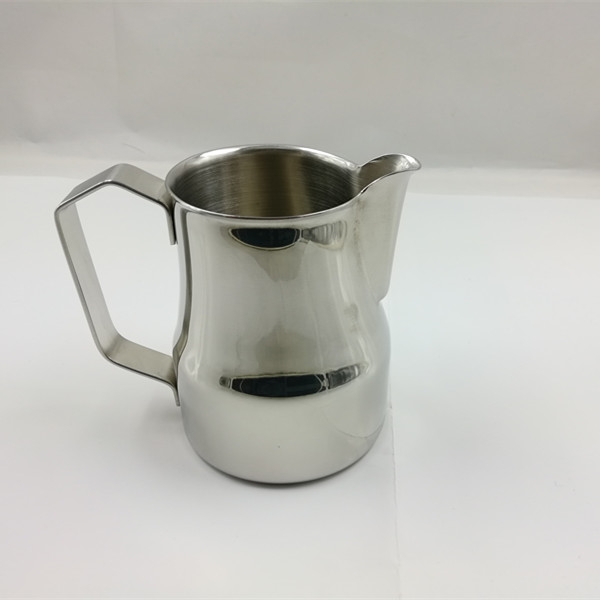
China Milk Frothing Pitcher distributor The decorative effect and protective effect of the coating are not only related to the properties of the metal substrate and the paint itself, but also directly related to the choice of the metal pretreatment process. The pre-painting process and quality determine the adhesion of the coating to the substrate, and the adhesion is closely related to the coating protection properties.
There are many kinds of surface pretreatment methods for stainless steel metal substrates, which are mainly selected in combination with the structural characteristics, size and yield of the coated objects. The main purpose of the pretreatment is to remove foreign matter on the surface of the substrate while obtaining a suitable surface roughness to facilitate better adhesion of the coating. Conventional surface pretreatment methods include grinding treatment, pickling passivation, and sand blasting. With the development of technology, metal adhesion promoters are now commonly used to solve them.
The enamel treatment agent stainless steel metal adhesion promoter is sprayed between the substrate and the paint coating to play the role of connecting the substrate and the paint coating on the hinge to effectively adhere and enhance the adhesion between the layers. The purpose of the paint loss problem is to test the salt spray. It is not only used for the spraying of stainless steel surface, but also widely used in the surface oil spraying process of zinc alloy, aluminum alloy, etc. to enhance the adhesion between the surface of the metal substrate and the paint coating, and spray the rubber paint on the metal hardware. The use of UV paint, ordinary paint, baking paint and other paint problems is obvious.