








ShenZhen E-BON Industrial Co..Ltd
-Professional manufacturer for the stainless steel products


A French shaker seals with nothing but two pieces of steel — no threads, no lugs, no gasket. That means only two things can go wrong: it leaks while you shake, or it locks shut after you do. Both come from the same set of dimensions. This is the engineering behind that joint: why it has to be a shallow cone rather than a press fit, the four values E-BON sets before cutting tooling (8–12 mm engaged length, 2°–3° taper per side, 0.10–0.25 mm interference, 0.5–1.0 mm axial clearance), why roundness rather than diameter is what buyers feel, why the mouth needs a separate sizing die after springback, and why a plated version cannot share the same mouth dimension as an unplated one.

Consolidates the etched-tumbler cluster from the 40-topic pool (production checklist, artwork requirements, defect prevention) into one buyer-facing guide: what etching is and how it differs from printing/debossing/embossing, artwork file requirements before quoting, defect-prevention checkpoints specific to etched surfaces (etching depth, edge deburring, pattern registration, cross-finish consistency), and MOQ/packaging using the real egg-shaped 20oz 304 stainless tumbler as a reference spec.
Explains the material difference between 304 and 201 stainless steel, why 201 shows up in aggressively priced barware quotes, where the difference actually shows up after an order ships (corrosion, finish stability, the unreliable magnet-test shortcut), and gives buyers a concrete way to confirm grade in writing before comparing supplier quotes.

Gives B2B barware buyers a practical way to tell a manufacturer from a trading company, explains what ISO 9001, Sedex 4-Pillar, and BSCI audits actually verify, and covers third-party testing and export documentation to confirm before sending an RFQ.
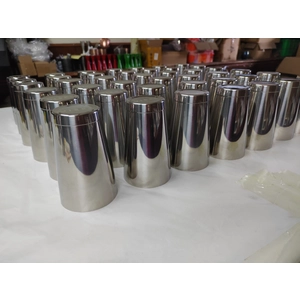
A bulk-order guide to etched stainless steel tumblers: how etching differs from printing, debossing and embossing, what artwork to prepare before quoting, the defect checkpoints specific to etched surfaces (etching depth, edge deburring, pattern registration, finish consistency), and MOQ and packaging, using a 20 oz egg-shaped 304 tumbler as the example.
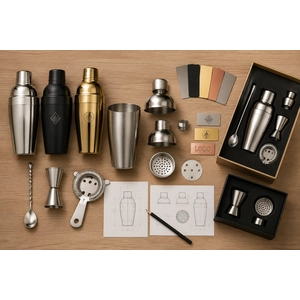
For private label barware brands: how to specify, sample and quote a custom cocktail shaker set, and how to keep its components, finish, branding, packaging and repeat orders consistent as one product.

A BOFU guide for private label barware brands defining how to specify, sample and quote a custom cocktail shaker set while keeping its components, finish, branding, packaging and repeat orders under one product system.

French press sediment does not come from one cause. This article separates normal metal-filter silt from excess sludge and visible grounds, then shows how grind distribution, mesh fineness, filter layers, edge fit and plunger resistance help identify the source.
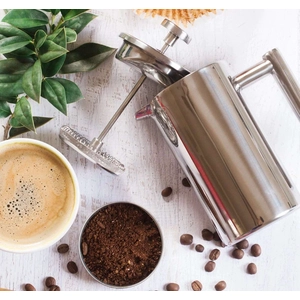
A practical French press answer page with an interactive ratio calculator, water-based ratio chart, six-step daily method, ratio and brew-time adjustments, grind guidance, and direct fixes for bitter, weak, sour, muddy, or sediment-heavy coffee.
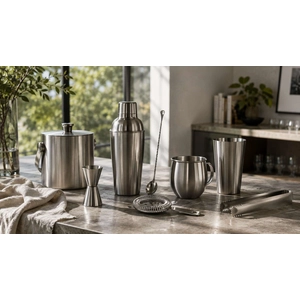
A practical framework for turning multiple shakers, jiggers, strainers, mugs and accessories into one recognizable barware collection through shared design anchors, controlled variation and range-level sample approval.

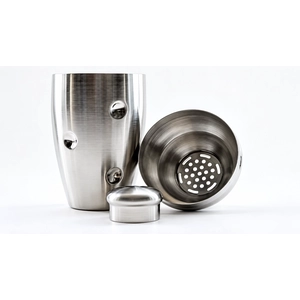
A French shaker has no threads, no lugs, no gasket and no built-in strainer. The seal comes entirely from the fit between cap and base.
There are only two complaints. It leaks while you shake it, or it will not come apart after you do. Both are the same variable set wrong in opposite directions.
Treating the joint as a cylinder (cap bore slightly under the base mouth, then push) leaves no working window. Loose and it leaks; tight and it locks once the drink goes cold.
It has to be a shallow cone. Both parts are cut to close to the same angle, so contact pressure rises as the cap travels. The hand pressing it down is what makes the seal, and it builds over the stroke instead of at one fixed ring. Howard Reichenbach's cocktail shaker patent for the Chase Companies (US1969386, filed 1933) uses the same sealing principle: a conical stopper matched to a tapered neck, pressed tighter by the hands during shaking, with a slight clearance between the cap edge and the shoulder of the body.
Taper fit                      Press fit
         /                       |   |
        /   8-12 mm              |   |   full-length
       /    engaged              |   |   cylinder
      /     progressively        |   |   binds at one point
     /                           |   |
    /                            |   |
These are the development starting values we give the tool shop on a French shaker, before any sample is tested:
| Parameter | Value | What moves if you change it |
|---|---|---|
| Engaged fit length | 8–12 mm | Shorter and the seal depends on one narrow ring, so any form error leaks |
| Taper, per side | 2°–3° | Shallower and small diameter differences move the seated height further, eating into the axial clearance. Steeper and the same hand pressure produces less sealing pressure |
| Diametral interference | 0.10–0.25 mm | This is the elastic squeeze on the engaged band only, not on the whole cap bore |
| Axial clearance when seated | 0.5–1.0 mm | If the shoulders touch first, the sealing cone has nowhere left to travel and hand pressure does nothing |
The taper angle does not make the joint release on its own. At 2°–3° a solid steel cone would hold by friction. A French shaker comes apart because both walls are thin enough to flex when the joint is tapped, which is why wall thickness is specified below.
A shaker can be dimensionally correct on every diameter and still leak because the cap bottoms out on its own shoulder before the cone is loaded.
Diameter is the number everyone checks; roundness is the one that produces the complaint. A mouth 0.3 mm out of round still looks round. Fitted to a cap, it is tight on one axis and open on the other, so it drips and still comes apart hard. The workshop reads that as a diameter problem, adjusts the diameter, and makes it worse.
Our target on the engaged band is 0.15 mm or better, with 0.10 mm as the working aim.
Deep-drawn 304 springs back. A tool cut at a given mouth diameter does not hand you that diameter after the part is released, and the error is not the same at the top of the run as at the bottom.
So the mouth is not finished by the draw. The sequence is:
draw → trim → neck / flare → sizing and rounding die → rim finish → polish → fit test
The sizing and rounding die is a separate tool that exists only to bring that 8–12 mm band back to the specified diameter and roundness after springback.
Plating adds material to both mating surfaces. Carry the same tooling and the same interference over to a copper, gold, rose gold or black plated version and the coating lands on the cap bore and the base mouth at once. The fit tightens from both sides, and the cold-shake release goes with it.
We subtract the coating build from the base steel dimensions so that the interference after plating lands back in the 0.10–0.25 mm window. The plated and unplated versions of the same shaker therefore do not share a mouth dimension, and should not be quoted as if they do.
Both halves need enough spring to return. Pair a 0.4 mm base with a 0.8 mm cap and every assembly deforms the base, because it is the only part that can give. After a few hundred cycles the mouth is no longer round and the shaker has gone loose permanently.
We hold the engaged band at roughly 0.5–0.7 mm on both parts for this product class.
Coarse brushing in the bore creates a hard spot that catches on release. Grip comes from the taper, the interference and the elasticity of the steel.
The engaged band goes out burr-free, with no draw scoring, no deep circumferential marks, a rounded edge, and the same surface condition all the way round.
We sample each lot under ISO 2859-1 (AQL), at the inspection level and AQL agreed for the order, and test for two things: it does not leak in normal use, and it opens after a cold shake. The cold test is the one that matters: a shaker that separates cleanly on a dry bench can still lock once ice, liquid and a cooled headspace are involved.
Caps and bases in the sample are paired at random rather than as matched sets, so interchangeability is part of acceptance: any cap from the lot has to work on any base.
Send the capacity, the body profile, the finish including any plating, and how the piece will be used. A shaker for a working service bar and one for a retail gift set are not toleranced the same way.
On a new French shaker we normally sample three interference levels across the 0.10–0.25 mm range with every other dimension held identical, and have the samples opened by working bartenders.
Our catalogue reference for this construction is the 0.75 L stainless steel French cocktail shaker, and the rest of the range sits under cocktail shakers. If you have not settled on the construction yet, Boston vs cobbler for commercial bars covers that decision first.