A private label hip flask may look like a small product, but sourcing it for wholesale, retail, promotional gifts, or branded gift sets requires clear control over material, wall thickness, finish, logo method, packaging, MOQ, sample approval, and bulk inspection.
Many supplier pages use the same words: stainless steel, custom logo, wholesale price, gift box, and low MOQ. These terms are useful at the first comparison stage, but they do not show whether the approved sample can be repeated in bulk production, whether the finish will stay consistent, or whether the quotation includes the same packaging, accessories, and carton requirements.
If you are comparing product options, you can also view our stainless steel hip flask product page as a reference while reading this sourcing guide.
Quick Answer: What Should Buyers Confirm Before Ordering Private Label Hip Flasks?
In short: compare private label hip flask quotations by full specification, not by unit price alone. Before approving a sample or placing a bulk order, buyers should confirm the material, wall thickness, unit weight, capacity, surface finish, logo method, packaging type, accessories, MOQ basis, sample approval standard, and inspection requirements.
Most sourcing problems come from missing details. A sample may be approved without a written specification, or two suppliers may quote very different scopes while using the same product name. Once finish, packaging, accessories, and carton details are included, the real project cost can change.
Guide Navigation
1. Hip Flask Material and Wall Thickness: What Buyers Should Verify First
One-sentence takeaway: "stainless steel" is too general; material, wall thickness, and unit weight should be confirmed before the sample becomes the bulk production reference.
When sourcing stainless steel hip flasks, the material description should be more specific than a simple stainless steel label. Different material grades, wall thicknesses, and forming processes can affect strength, hand feel, cost, and bulk consistency.
A common case is that the approved sample feels solid, but the bulk order arrives lighter because the wall thickness or unit weight was never recorded in the specification sheet. This may not be obvious in product photos, but it becomes clear once the goods are handled, packed, or shipped.
Before sample approval, buyers should confirm stainless steel material, wall thickness, unit weight, capacity, inner surface condition, surface finish, and available material or food-contact documentation. Wall thickness and unit weight are useful reference points for later inspection.
For example, if an approved sample is confirmed at 0.7 mm wall thickness and around 184 g unit weight, that data should be recorded in the specification sheet. During bulk inspection, random weight checks and hand-feel comparison can help confirm whether the bulk goods match the approved sample.
2. Hip Flask Capacity and Shape: Avoid Choosing a Generic SKU Without Context
One-sentence takeaway: capacity should be checked together with packaging, accessories, and sales channel.
Common hip flask capacities include 4 oz, 5 oz, 6 oz, 7 oz, 8 oz, and 10 oz. Among them, 6 oz and 8 oz are frequently used for wholesale, promotional gift, and retail projects. A familiar capacity, however, does not automatically make a product suitable for every channel.
Some buyers choose an 8 oz flask because it is a common size, then later find that the box size, shipping weight, or gift set layout does not fit their retail plan. Capacity, shape, packaging, and accessories should be reviewed together before the project is confirmed.
For large-volume promotional orders, a standard capacity, classic shape, simple logo, and basic packaging may be enough. For retail or private label products, the same flask may need a stronger surface finish, branded packaging, barcode label, insert tray, or accessory set.
Shape also affects differentiation. A classic rectangular hip flask is stable, familiar, and easy to produce, but it is widely available in the market. Curved, round, vintage-style, or textured flasks can create stronger private label identity, but they may require additional confirmation on tooling, surface treatment, packaging size, and MOQ.
3. Hip Flask Surface Finish: A Good Sample Photo Does Not Guarantee Bulk Stability
One-sentence takeaway: surface finish should be checked for scratch risk, color consistency, edge coverage, and packaging protection before bulk production.
Surface finish is one of the most important parts of private label hip flask sourcing. It affects appearance, perceived value, scratch visibility, packaging requirements, and final retail presentation.
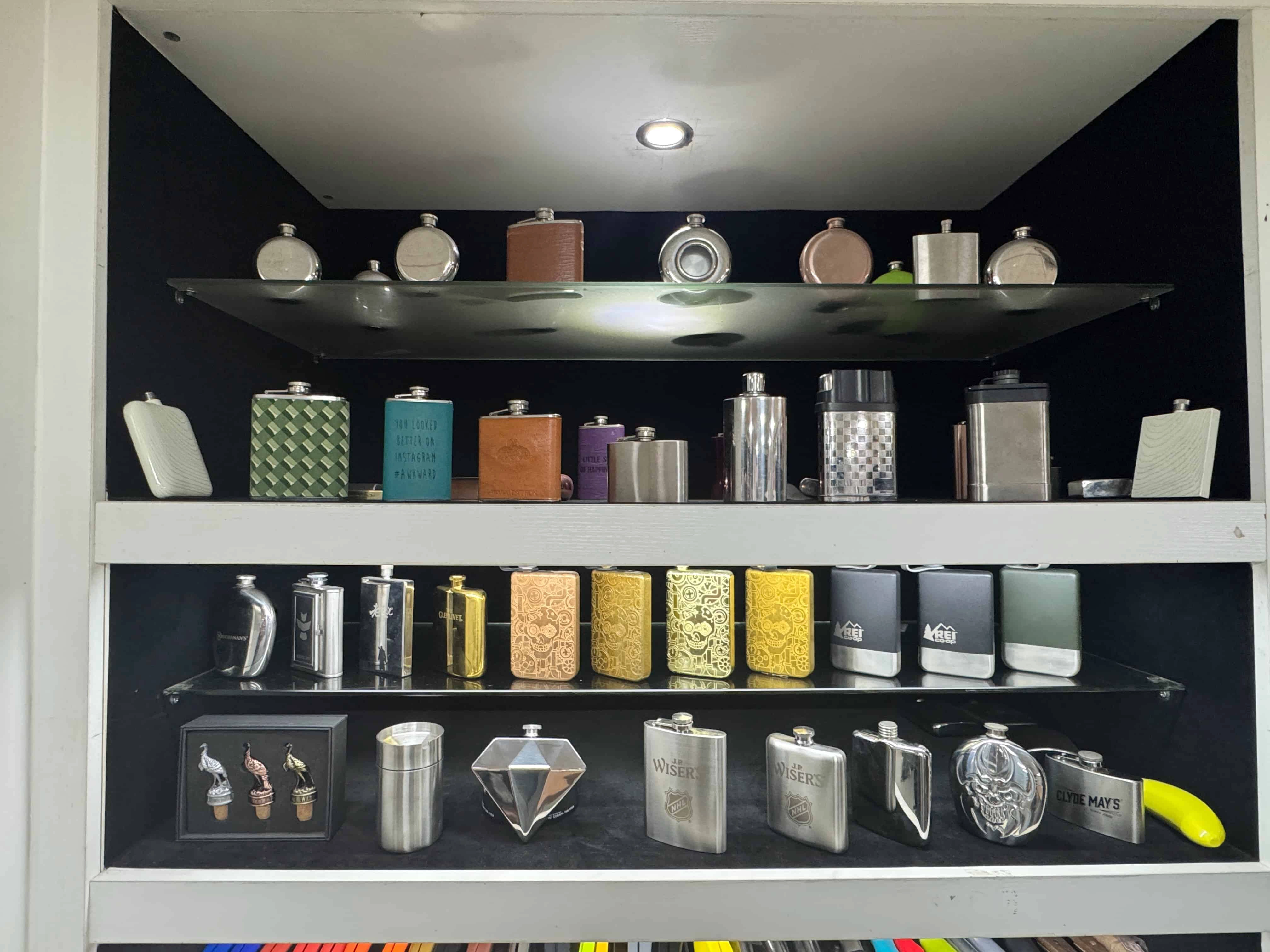
Common surface finishes include mirror polish, brushed finish, matte finish, black finish, gold finish, copper finish, and etched texture. A finish that looks clean in a single sample photo may show scratches clearly after carton packing, especially on mirror, black, gold, and copper surfaces.
Mirror polish gives a classic stainless steel look, but scratches, fingerprints, and small dents may appear more visible. Brushed finish usually looks more stable because it hides minor handling marks better. Black, gold, copper, and other plated or coated finishes can create a stronger gift or retail impression, but they require closer attention to scratch resistance, color consistency, edge coverage, and packaging protection.
For etched texture or full-surface pattern designs, buyers should check pattern edge clarity, depth consistency, curved surface distortion, and the visual match between the cap and flask body. A clean sample is useful, but the real test is whether the same finish can be repeated across the full batch.
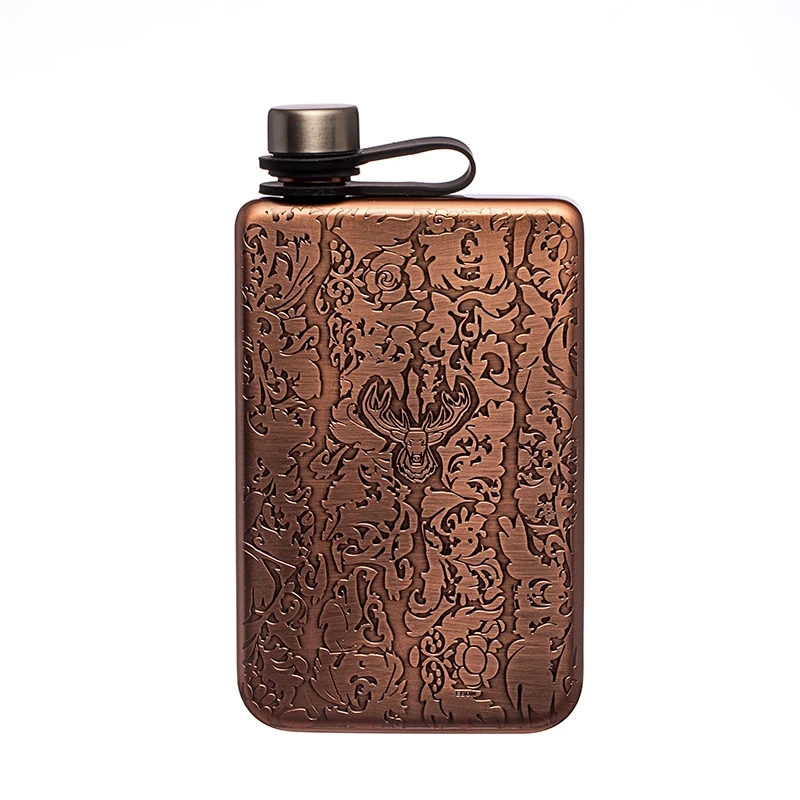
Etched texture can make the whole flask surface part of the product design instead of limiting branding to a small logo position. For private label buyers who want to avoid another plain polished flask, etched texture can help create a more distinctive product line.
4. Custom Logo Hip Flask Options: Confirm Bulk Consistency, Not Only Feasibility
One-sentence takeaway: logo approval should cover position, size, depth, edge clarity, and batch consistency.
Custom logo decoration is one of the most common requirements for private label hip flasks. Logo problems usually appear after bulk production starts: the engraving depth changes, the position shifts slightly, or the edges look less clean than the approved sample.
Common logo methods include laser engraving, silk screen printing, UV printing, embossing, debossing, and etching. Laser engraving works well on many stainless steel surfaces and is often used for clean and durable logo customization. Printing can be suitable for colored logos or promotional projects, but adhesion should be checked according to the surface finish.
Embossing and debossing create a stronger three-dimensional effect, but they usually require tooling and more preparation before production. Etching or full-surface decoration is more suitable when the buyer wants the entire flask to have a stronger visual identity.
For gift companies, liquor brands, and retail buyers, logo quality is part of the brand presentation. Before approving production, buyers should confirm the logo size, position, color or engraving depth, artwork version, and surface effect. If the project includes a color box, gift box, or set packaging, the logo on the product and packaging should be reviewed together.
5. Private Label Hip Flask Packaging: Do Not Leave Packaging Confirmation Until the End
One-sentence takeaway: packaging should be confirmed early because it affects MOQ, lead time, product protection, and retail presentation.
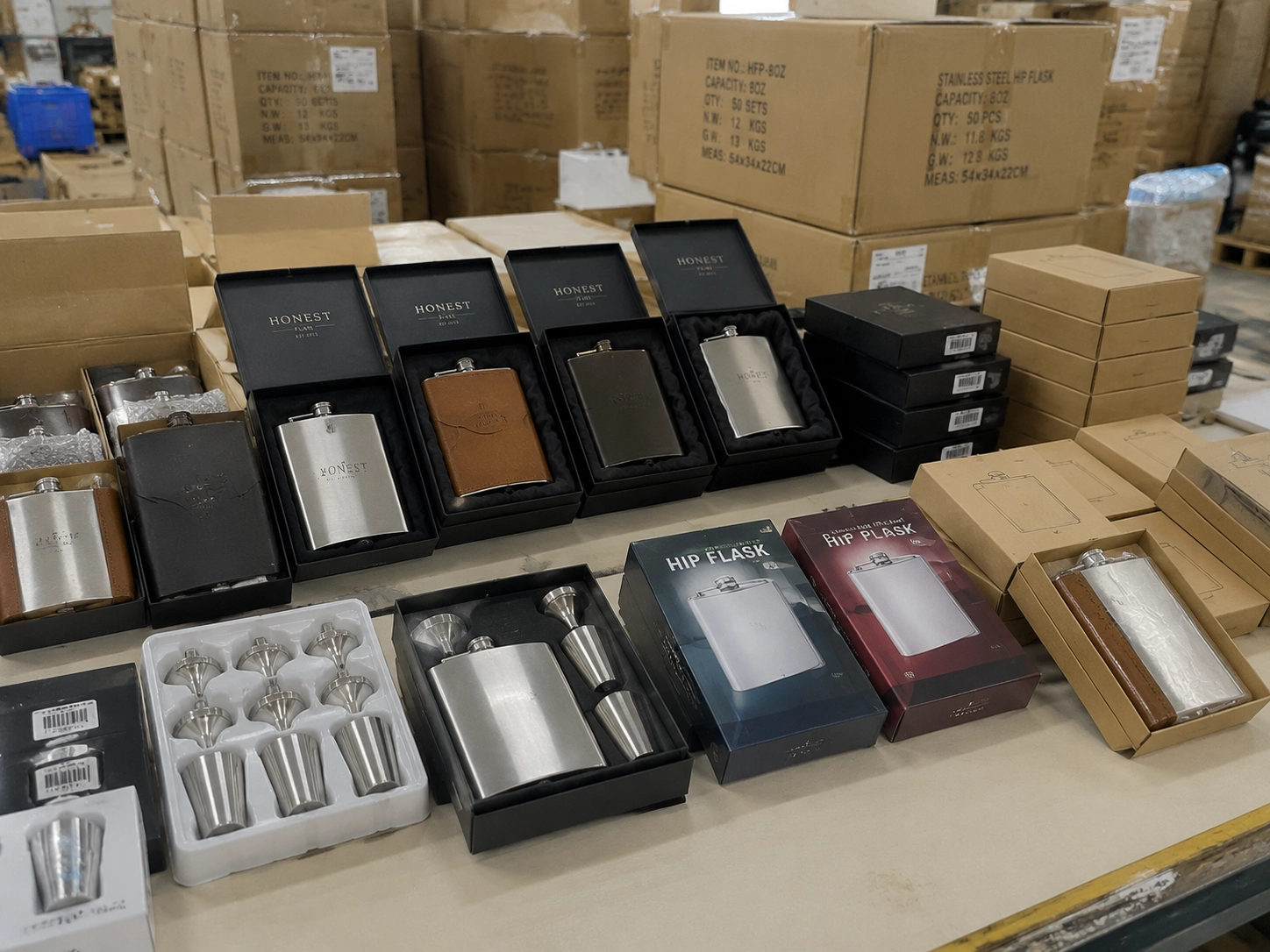
Packaging directly affects product cost, retail appearance, packing method, shipping protection, and sales channel. Many sourcing projects begin with the flask unit price, then discover later that color boxes, gift boxes, insert trays, barcodes, carton marks, and accessories change the final cost and production schedule.
Packaging issues often show up late in the project. A flask may already be approved, but the insert tray is too loose, the printed box has a higher MOQ, or the plated surface becomes scratched because the inner protection was not confirmed.
For basic wholesale orders, a white box or plain box may be enough. For retail or ecommerce orders, buyers may need printed color boxes, kraft boxes, barcode labels, SKU labels, product information, and outer carton marks. For gift orders, packaging may include rigid gift boxes, window boxes, insert trays, funnels, shot cups, or pouches.
The box must match both the product and the sales channel. If the insert tray is too loose, the flask may rub against the packaging during transportation. If the insert is too tight, the product may be difficult to remove. If plated or mirror-polished flasks are not individually protected, scratches may appear before the goods reach the buyer's warehouse.
6. Hip Flask MOQ: Ask How It Is Calculated, Not Only the Lowest Quantity
One-sentence takeaway: MOQ should be separated by flask body, finish, logo, packaging, accessories, and complete set.
MOQ is rarely one clean number in a private label hip flask project. A buyer may meet the flask body MOQ, but still fall short of the printed box MOQ, gift box MOQ, accessory MOQ, or special finish MOQ.
One common sourcing delay happens when the flask body MOQ is acceptable, but the printed box or accessory set has a higher minimum run. The project looks workable at the quotation stage, then becomes difficult to proceed once every customized component is confirmed.
- Flask body MOQ
- Surface color MOQ
- Logo process MOQ
- Printed box MOQ
- Gift box MOQ
- Accessory MOQ
- Mixed style or mixed color MOQ
A clearer quotation should separate the product, logo, finish, packaging, accessories, and export carton requirements. This makes it easier to adjust the project if the budget or quantity changes.
7. Private Label Hip Flask Sample Approval: Use the Sample to Lock the Bulk Standard
One-sentence takeaway: the approved sample should become the bulk production reference, not just a photo confirmation.
For private label hip flask orders, sample approval is especially important when the project includes a special finish, custom logo, etched texture, printed packaging, gift box, or accessory set.
A photo can confirm the general appearance, but it cannot fully lock color tone, logo depth, cap feel, surface texture, packaging fit, or accessory matching. If the approved sample is only confirmed by photos, these details may become disputes during final inspection.
- Material and wall thickness
- Unit weight
- Capacity
- Surface finish effect
- Logo position and size
- Pattern clarity
- Cap opening and closing feel
- Leak performance
- Packaging structure
- Accessory matching
- Barcode, label, and carton information
For private label products, the approved sample should be treated as an inspection reference. Physical samples, sample photos, specification sheets, and artwork files should be kept for comparison during bulk production and final inspection.
8. Hip Flask Quality Inspection: Focus on Issues That Affect Sales and Complaints
One-sentence takeaway: quality inspection should focus on leakage, cap thread, weld seam, surface scratches, logo consistency, and packaging protection.
Quality control should be tied to real product risks. For hip flasks, inspection should focus on the areas that affect use, appearance, and customer complaints.
For private label gift orders, a flask can pass a basic function check but still fail commercially if the surface is scratched, the logo looks inconsistent, or the gift box arrives damaged.
- Leak test
- Cap thread
- Weld seam
- Body deformation
- Inner surface cleanliness
- Sharp edges or burrs
- Surface scratches
- Color consistency
- Logo position and clarity
- Packaging protection
- Carton packing method
Leakage and cap threading are basic functional issues. Surface scratches and inconsistent logos affect retail and gift value. Packaging inspection is also part of product quality because a qualified flask can still become a rejected product if it is scratched during transportation.
9. Hip Flask Quote Comparison: Compare Complete Specifications, Not Only Unit Price
One-sentence takeaway: a lower unit price is not meaningful unless both quotations include the same material, finish, logo, packaging, accessories, and carton requirements.
The unit price of a hip flask should be compared based on the full specification. If two suppliers quote different prices, the difference may come from material, wall thickness, surface finish, logo process, packaging, accessories, or carton packing method.
| Item to Compare |
Why It Matters |
| Material grade |
Affects durability, cost, and documentation |
| Wall thickness and unit weight |
Helps compare whether two quotes use the same flask body |
| Capacity and shape |
Affects packaging size, hand feel, and sales channel |
| Surface finish |
Changes appearance, scratch risk, and packaging requirement |
| Logo method |
Affects setup cost, durability, and bulk consistency |
| Packaging type |
Can change MOQ, lead time, and retail readiness |
| Accessories |
Funnel, cups, pouch, or insert tray may not be included in the base price |
| MOQ basis |
Flask body MOQ and packaging MOQ may be different |
| Sample approval standard |
Prevents disputes during bulk inspection |
| Carton marks and labels |
Important for importers, distributors, and ecommerce warehouses |
A more reliable comparison is to ask suppliers to quote based on the same specification: same capacity, material, wall thickness, finish, logo method, packaging, accessories, and quantity.
10. RFQ Checklist for Private Label Hip Flask Projects
One-sentence takeaway: a clear RFQ helps suppliers quote the real project, not the lowest possible version of the product.
To receive a more accurate quotation, buyers can prepare the following information before sending an inquiry:
- Target capacity: 4 oz, 6 oz, 8 oz, 10 oz, or another size
- Target order quantity
- Material or wall thickness requirement
- Unit weight requirement, if any
- Flask body shape reference
- Surface finish: mirror, brushed, matte black, gold, copper, etched texture, or another finish
- Logo file
- Preferred logo method
- Full-surface pattern or partial texture requirement
- Packaging type: white box, color box, kraft box, gift box, or set box
- Required accessories: funnel, shot cups, pouch, insert tray, or others
- Target price range
- Sales channel: wholesale, promotional gift, ecommerce, retail, liquor gift set, or other channel
- Destination country
- Required material or food-contact documentation
- Sample timeline
- Expected delivery schedule
If the information is not complete yet, buyers can start with the target market, reference images, and budget direction. A clear RFQ reduces back-and-forth communication and helps prevent suppliers from quoting the lowest possible configuration that cannot support the actual project.
11. Choosing a Private Label Hip Flask Supplier: What to Look For
One-sentence takeaway: a reliable supplier should define the sample, specification, surface finish, logo method, packaging, MOQ, and inspection standard before production.
A weak supplier usually gives a fast price first and confirms details later. A stronger supplier may take more time before quoting, but will confirm the flask body, finish, logo, packaging, MOQ basis, and inspection standard before production.
- Confirm the full specification before quotation
- Use the approved sample as a bulk reference
- Explain material, wall thickness, unit weight, and surface finish
- Recommend a suitable logo method according to the selected surface
- Support basic packaging, retail packaging, or gift set packaging
- Explain how MOQ is calculated for different customized parts
- Check leakage, cap threading, weld seams, surface finish, and logo consistency
- Confirm carton packing and shipping marks before shipment
FAQ About Private Label Hip Flask Sourcing
What is the usual MOQ for private label hip flasks?
The MOQ depends on whether the buyer needs a stock flask, custom logo, special finish, printed box, gift box, or accessory set. Buyers should confirm whether the MOQ is calculated by flask body, surface color, packaging, or complete set.
Can I order hip flasks with a custom logo?
Yes. Common logo methods include laser engraving, silk screen printing, UV printing, embossing, debossing, and etching. The best method depends on the selected surface finish and the expected logo effect.
Does packaging affect the hip flask MOQ?
Yes. Printed boxes, gift boxes, insert trays, and accessory sets may have their own MOQ. A project may meet the flask body MOQ but still fall short of the packaging MOQ.
What should I check before approving a hip flask sample?
Buyers should confirm material, wall thickness, unit weight, capacity, surface finish, logo position, logo clarity, cap thread, leak performance, packaging structure, and accessory fit.
How can I compare two hip flask quotations?
Compare the same specification: capacity, material, wall thickness, unit weight, finish, logo method, packaging, accessories, MOQ, and shipping carton requirements. A lower unit price is not meaningful if the scope is different.
Final Notes
Private label hip flask sourcing depends on how clearly the material, wall thickness, surface finish, logo method, packaging, MOQ, sample approval, and bulk quality control are confirmed before production.
For basic wholesale orders, stable specifications, simple logo decoration, and cost control may be the priority. For retail or gift projects, surface quality, packaging completeness, and brand presentation become more important. If the product needs to stand apart from ordinary plain flasks, etched texture, special finishes, custom logo placement, and gift set packaging can help create stronger visual differentiation.
Before requesting a quote, prepare the capacity, quantity, finish, logo, packaging, accessories, and target price as clearly as possible. This gives the supplier enough information to provide a more accurate quotation and a production plan that can actually be delivered.
Request a Private Label Hip Flask Quote