


ShenZhen E-BON Industrial Co..Ltd
-Professional manufacturer for the stainless steel products
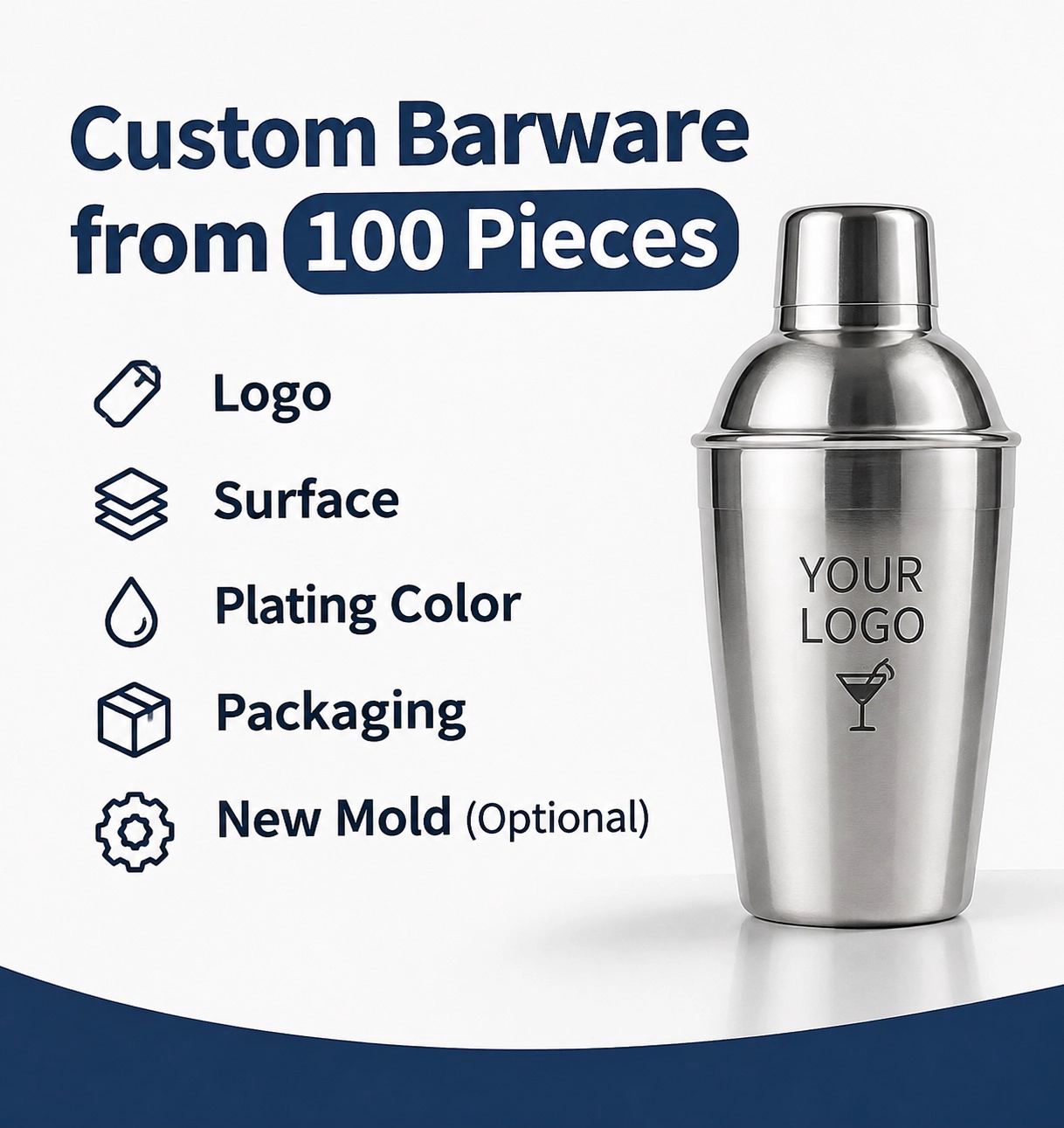
At 100 pieces you can change the logo, surface, plating color and packaging on an existing barware model, or have a new mold made; you are not limited to a laser logo on a stock item. What moves the unit price at that quantity is one-time setup work, such as tooling and machine setup, spread over only 100 pieces, so a first order with fewer one-time setups costs less per piece.
We also take orders below 100 pieces. With freight, mold fees and no volume discount on so few custom pieces, though, the unit price becomes very high.
On an existing model, a 100-piece order covers the same four layers as a larger one. You specify each separately:
| Customization | What you can choose at 100 pcs |
|---|---|
| Logo | Laser engraving, etching, stamping, silk screen printing, embossing or debossing, depending on the item's shape |
| Surface and plating color | Mirror, brushed, textured; copper, gold, rose gold, color coating, etched patterns |
| Packaging | White box, color box, gift box, Amazon FBA packaging |
| New mold | Drawing, then structural and 3D drawing, then tooling; the mold is yours alone and the drawings stay confidential |
Two of these make a small order noticeably more expensive: a new mold, and a special material. The section on cost below explains why.
You can customize an existing stock model or develop a new mold at the same 100-piece minimum. The difference is the tooling: a stock model uses a mold that already exists, so there is no mold cost and no mold time in your order.
A new shape or structural feature is also open at 100 pieces. The work goes from your drawing to a structural and 3D drawing, then to tooling. The mold is used only for your product, and your drawings stay confidential.
For more on when to adapt an existing body and when to build your own, see Cocktail Shaker OEM vs ODM. If you are developing a new shape, our guide to designing custom barware for your brand covers the drawings and artwork to prepare.
Suppliers set minimum order quantities so each order covers costs that don't shrink when the order does. Shopify's guide to minimum order quantity lists them: tooling, machine setup and changeovers, and labor time per run. Suppliers may also set a minimum for each color and size they make.
On a 100-piece order, those fixed costs are shared by fewer pieces, and below 100 they are shared by fewer still. Freight and mold fees weigh more on each piece, and an order that small gets no volume discount.
In our production, two choices make a small order noticeably more expensive:
Printed packaging is a second place where setup shows up. As Packwire explains, offset printing needs a custom metal plate for each design, and that plate is the most expensive part of the job, so offset pays off on large, repeated runs. Digital printing needs no plates or setup fees and is the better choice for small runs. For 100 pieces, a simpler box keeps that setup down.
Because fixed setup costs don't shrink with the order, every one-time setup you leave out of the first run lowers the cost per piece.
The same approach applies to any category. For hip flasks, our private label hip flask sourcing guide covers materials, finishes, logos and packaging in detail.
Lead times depend on which path you take:
Before you compare quotes, make sure every supplier is pricing the same steel: our guide to 304 vs 201 stainless steel barware explains what to confirm. When the sample arrives, our pre-production sample checklist covers what to check before you approve bulk production.
For an accurate quote on a 100-piece order, send:
Send these to our OEM and customization team with your stock model or drawing, and we will come back with a sample and a quote.