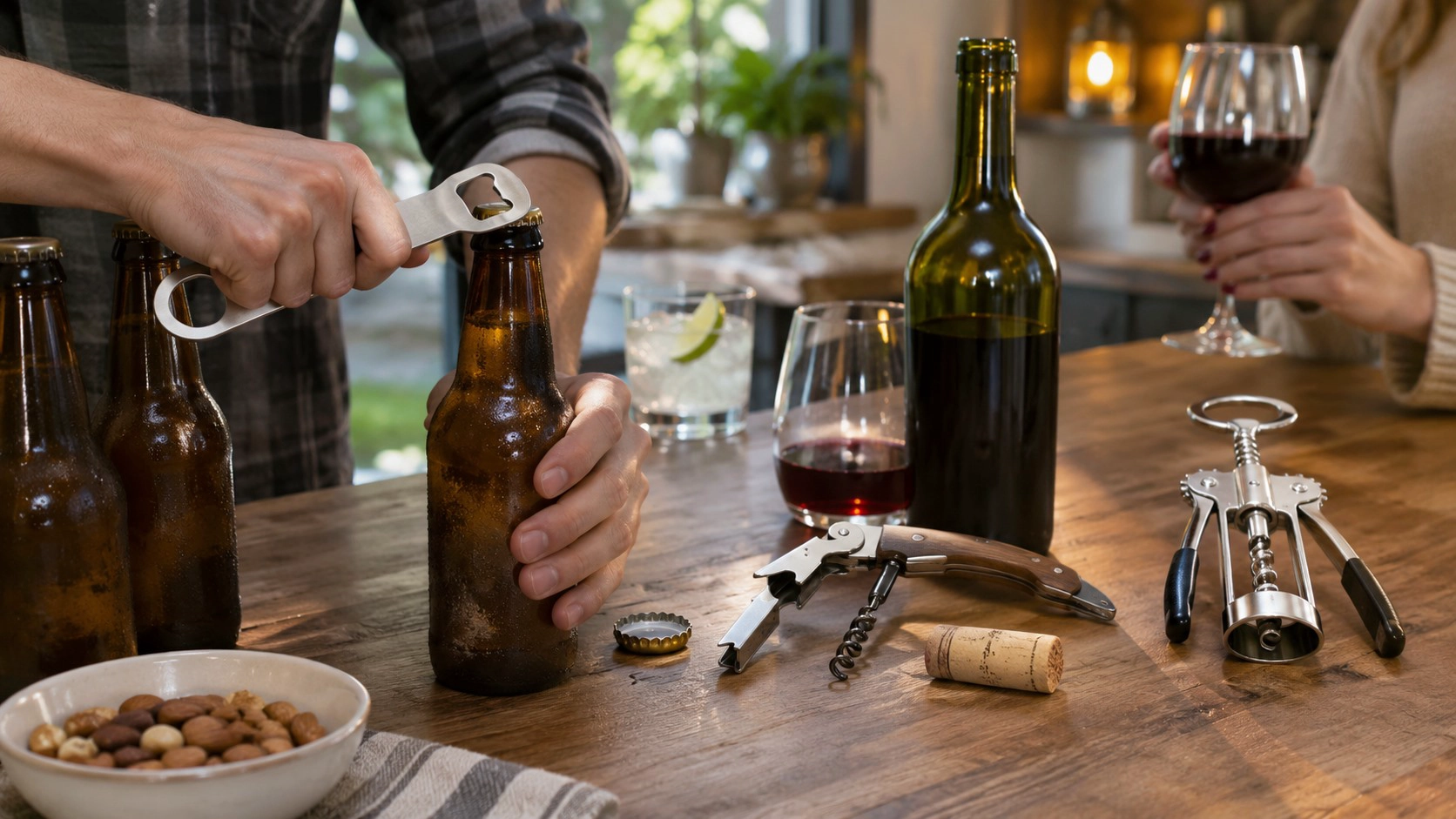
Most broken corks and bent bottle caps are not caused by weak hands. They happen because someone matched the wrong lever geometry to the closure, or because a low-cost promo opener gave way under commercial load.
Before comparing the main types of bottle openers, one market distinction matters for sourcing and staff training: in US hospitality and retail, a bottle opener usually means a prying tool for crimped metal crown caps on beer and soda bottles, while a corkscrew is built to pull wine corks. Treating them as one category leads to loose hinges, chipped glass necks, and high replacement costs behind the bar.
For buyers, picking the right mix comes down to three variables: unit budget, sales channel, and opening frequency. High-frequency bar service needs rigid stainless steel that holds its edge over thousands of caps, retail gift lines pay more for self-centering mechanics and finish weight, and short-run brand giveaways prioritize light weight and low unit cost over multi-year wear.
Bottle Openers vs. Corkscrews: Why Structure Dictates Survival
Crown caps and wine corks fail under completely different forces. A crown cap has crimped steel teeth locked around a glass lip, so removing it cleanly requires a stiff metal catch that hooks under the far edge and lifts in one snap. A natural or synthetic wine cork seals through radial friction inside the neck, which demands a centered helix worm and a straight vertical pull.
Using a corkscrew's small lever notch to pry beer caps all night loosens the hinge rivet. Using a soft promotional keychain opener on a busy bar shift rounds out the catch lip within weeks. Keeping crown-cap tools and cork-pulling tools separate in your purchasing spec is the fastest way to cut tool failure.
Types of Bottle Openers and Corkscrews at a Glance
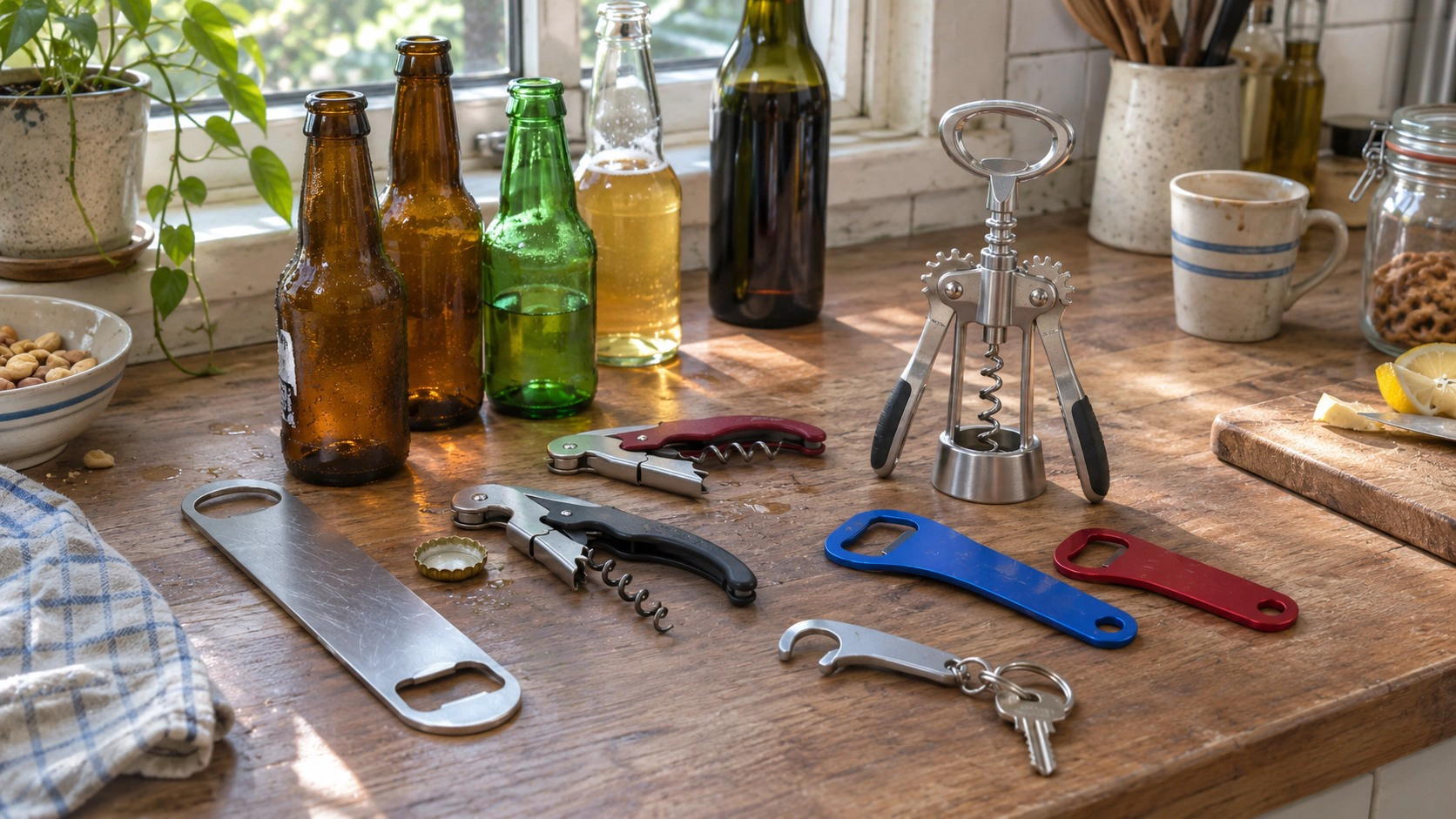
Commercial venues and promotional programs rely on seven core structures across crown-cap and cork closures:
| Opener Type |
Closure |
Relative Cost |
Best Channel & Frequency |
Key Structural Limit |
| Bar Blade (Speed Opener) |
Crown caps |
Low-Mid |
High-volume bars, breweries, nightly speed rails |
Cannot pull wine corks |
| Promotional Openers (Keychain Form or Aluminum Body) |
Crown caps |
Low |
Event giveaways, beer merch, low-frequency promo |
Keychain relies on short reach; soft aluminum lips wear under nightly bar use |
| Finger Ring Bottle Opener |
Crown caps |
Low |
Outdoor festivals, novelty retail, light pours |
Very short lever arm; takes more hand force on tight caps |
| Double-Hinged Waiter's Corkscrew |
Wine corks & crown caps |
Low-Mid |
Restaurants, sommeliers, wine bars (daily service) |
Requires basic two-handed technique |
| Single-Hinged Waiter's Corkscrew |
Standard wine corks |
Low |
Compact promo kits, casual wine programs |
Higher risk of snapping long or dry corks on the final quarter |
| Wing Corkscrew |
Standard & tight synthetic corks |
Mid |
Home bars, retail gift sets, casual dining |
Bulky for pockets; soft cast gears wear under heavy use |
| Lever Corkscrew |
Frequent wine service |
Mid-High |
Tasting rooms, banquet prep, giftware |
Heavy footprint; jaws must clamp firmly to prevent slipping |
Commercial vs. Promotional Crown Openers: Bar Blade, Aluminium, Keychain, and Finger Ring
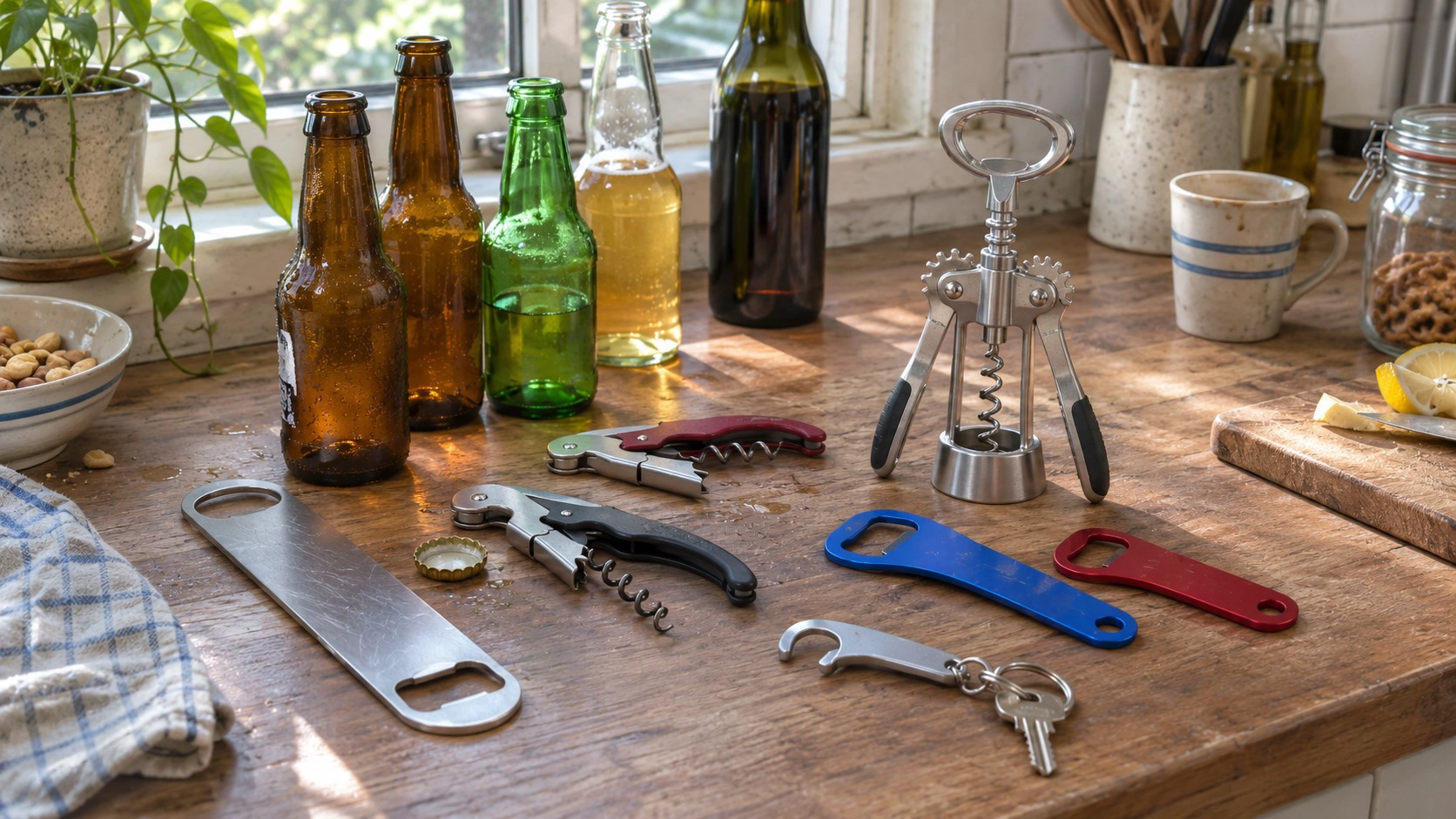
All crown-cap openers share the same goal, yet their survival rate behind a bar varies dramatically by material rigidity and lever length.
A flat stainless steel bar blade bottle opener is the standard speed-rail workhorse because its long body multiplies hand leverage and its wide cutout grips multiple crimps at once. In practice, you grip the neck with your non-dominant hand, hook the slot under the far edge of the cap, brace your index knuckle as a stop, and snap upward toward your body. Never twist the blade sideways like a screwdriver, which chips thin glass necks and bends soft metal.
Where buyers often make a costly mistake is ordering promotional styles for working bar service. When sourcing low-cost giveaways, keep structure and material distinct: keychain defines a compact carry form, while aluminum defines a lightweight, softer alloy body. Both a stamped aluminium bottle opener (available in paddle or pocket profiles) and a custom logo metal bottle opener keychain (typically cast or stamped metal on a split ring) make sense for beverage brand activations, brewery merch, and low-budget mailers. Aluminum cuts shipping weight and takes vibrant anodized colors with clean laser contrast, and keychain formats keep a logo in front of consumers daily. Put a soft aluminum catch lip on a shift opening hundreds of bottles a night, however, and the edge flares out quickly. Reserve aluminum bodies and keychain formats for retail merch and occasional use; specify rigid stainless steel bar blades for commercial hospitality venues.
A stainless steel finger ring bottle opener sits in between as a compact wearable tool for festivals or fast pours. Because the lever arm is only the width of a finger, it clears loose caps fast without setting down a bottle, though it gives far less mechanical advantage on stubborn caps than a full-length bar blade.
Waiter's Corkscrews: Single vs. Double Hinged in Real Service
Among wine openers, the folding waiter's key remains the hospitality benchmark because it fits flat in an apron pocket and gives servers tactile feedback on fragile corks. Almost every broken cork traces back to two habits: cutting the foil at the very top rim (leaving sharp wrap edges in the pour path) instead of beneath the lower glass ridge, or driving the worm in off-center.
Center the tip of the spiral worm straight into the cork, twist clockwise until half a turn remains visible above the cork so you do not push crumbs into the wine, and then let the hinge geometry do the work:
- With a double-hinged waiter's corkscrew: Seat the shorter first notch on the rim, lift halfway, then drop to the longer second notch and pull straight up. Resetting the pivot keeps the cork moving along the neck axis instead of bending against the glass.
- With a single-hinged waiter's corkscrew: Pull slowly to three-quarters height with your thumb bracing the hinge, then stop levering and ease the last quarter out by hand. Forcing a full pull on one pivot snaps long or dry vintage corks.
Self-Centering Corkscrews: Wing and Lever Mechanisms
When buyers need an opener that works reliably with zero staff training, frame-guided designs remove the guesswork of angle and pivot control.
A stainless steel wing corkscrew seats a circular collar squarely over the bottle lip, forcing the worm straight down the center of the cork as you turn the top handle. Stop turning as soon as both wings reach full height, then press them down evenly with both palms so the geared rack lifts the cork vertically.
For tasting rooms and banquet prep where speed outweighs pocket size, a zinc alloy lever corkscrew drives and extracts a cork in two fast strokes. Clamp the side jaws tight around the neck, push the lever down to thread the screw, and pull back up to extract. The single operational failure point is grip pressure on the neck: if the jaws relax mid-pull, the screw strips out of the cork instead of lifting it.
Why Openers Fail on the Floor: The Manufacturing Shortcuts Behind Broken Corks
When end users complain that an opener feels flimsy or shreds corks, the root cause is rarely mystery user error. On the production floor, three tooling and material shortcuts explain almost every failure pattern:
- Solid auger screw vs. milled open-spiral worm: Cheap promotional corkscrews often use a thick solid center-post screw that drills out a core like a wood screw, hollowing the center of the cork so the outer wall tears apart mid-pull. A proper open-helix worm with a sharp tapered tip wraps around a solid cork column and distributes lifting tension evenly.
- Loose hinge rivets and thin frame plates: On folding wine keys, under-peened rivets or thin side plates allow lateral play the moment you pull a tight synthetic cork. Once the lever twists off-axis, the cork binds against the bottle neck.
- Soft or poorly finished working edges: Unhardened aluminum edges round off on crown caps, while poorly deburred stamped slots on steel bar blades can snag knuckles or scratch glassware during fast service.
What Bulk Buyers Should Inspect Before Approving Samples
Treat pre-production opener samples as mechanical tools rather than cosmetic giveaways. Run through these seven checks before signing off on mass production:
| Inspection Point |
Commercial Risk Prevented |
What to Verify on Your Sample |
| Spiral worm geometry |
Cork crumbling and mid-pull tearing |
Confirm a sharp tapered tip and open-helix profile on both natural and synthetic corks |
| Hinge and rivet tension |
Lever twisting and early joint failure |
Cycle both hinges repeatedly; reject any side-to-side play or gritty binding |
| Bar blade rigidity |
Permanent bending on tight crown caps |
Flex the body manually and pry test caps to confirm the blade returns flat |
| Catch-slot geometry |
Cap slipping and chipped bottle necks |
Test the slot on your target crown caps to verify full bite on the first pull |
| Wing gear synchronization |
Uneven lifting and stripped gear teeth |
Run the T-handle through full travel to confirm smooth rack meshing without skipping |
| Lever jaw grip |
Screw stripping out of tight corks |
Clamp and pull across standard neck profiles to confirm the jaws stay locked |
| Edge deburring and plating |
Bartender hand cuts and flaking finish |
Run fingers along slots, foil blades, and handles to rule out burrs or peeling plating |
If your program bundles openers with stoppers, pourers, or foil cutters into retail gift boxes, pair these single-unit checks with our guide to custom wine accessory sets to align finishes, box inserts, and branding across components.
Matching Opener Types to Your Purchasing Program
Across the main types of bottle openers, the right lineup depends on service volume, user skill, and branding budget:
- High-volume bars and breweries: Standardize on rigid stainless steel bar blades for crown caps and double-hinged waiter's corkscrews for table wine. Separating cap and cork duties keeps hinge joints tight across busy shifts.
- Restaurants and wine hospitality: Specify double-hinged waiter's corkscrews with an open-spiral worm and serrated foil knife. Reserve single-hinged models for budget promo kits rather than sommelier service.
- Brand promotions, merch, and retail gifts: Use aluminum and keychain openers for lightweight logo giveaways, finger ring openers for festival merch, and wing or lever corkscrews where easy home use and larger branding surfaces matter.
Compare all available profiles in our wholesale bar accessories catalog, and send your target quantities, surface finish preferences, and vector logo artwork when requesting pre-production samples.