Introduction
A US-based premium barware brand came to us with a production crisis. Their existing supplier had delivered 5,000 double-sided stainless steel jiggers — and their QC team, using a manual volumetric test, found that 23% of units deviated by more than 2ml on the 1oz side. For a brand positioned at $40+ retail per unit and marketed to high-volume cocktail programs, that's not a cosmetic defect. It's a liability.
The root cause wasn't poor craftsmanship in the traditional sense. It was that their previous manufacturer was applying consumer-grade tolerances to a product that demanded engineering-grade precision. The two are not the same.
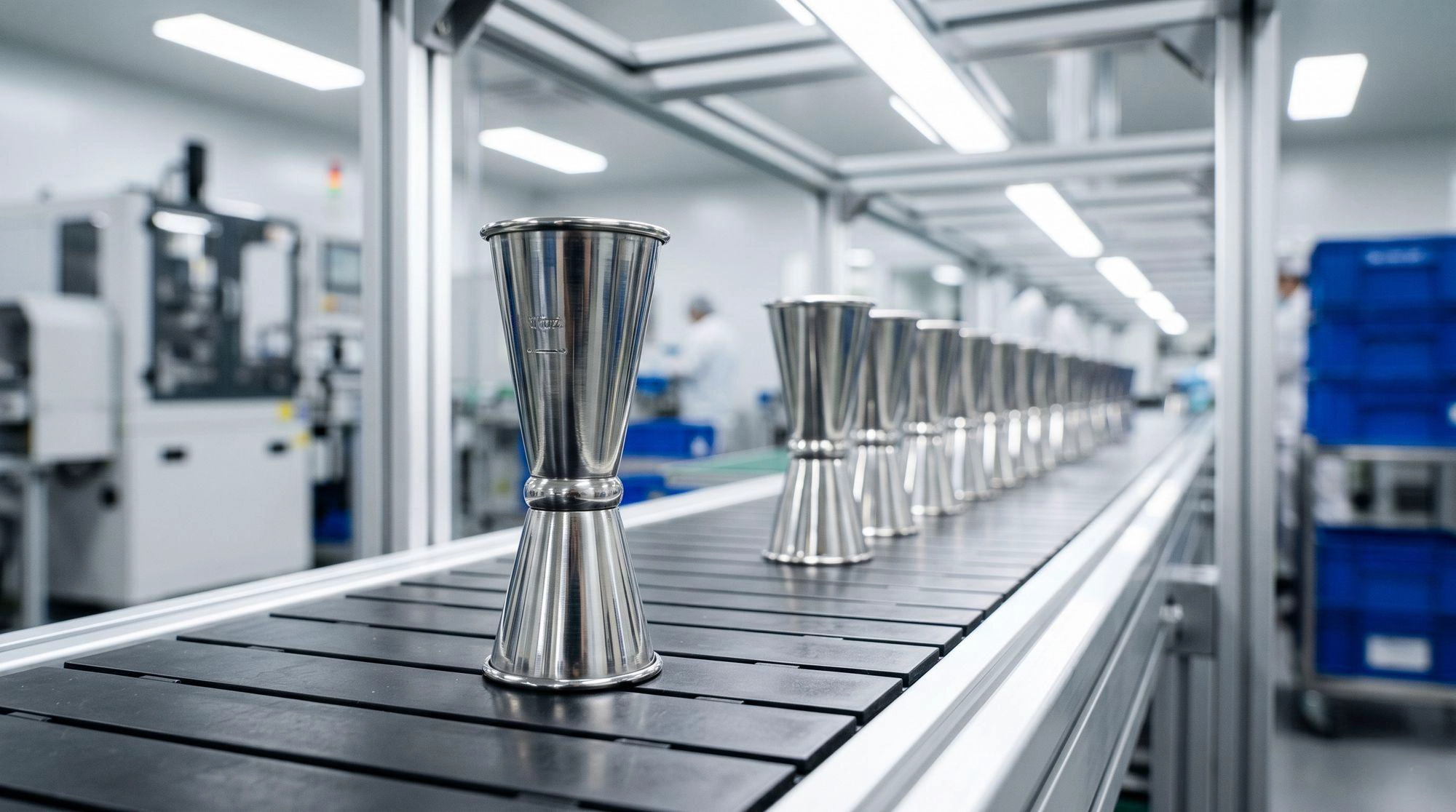
This case study documents how we, as a dedicated stainless steel jigger manufacturer, re-engineered their production process from raw material selection through final QC — and delivered a verified 0.5ml (±0.03oz) tolerance at scale using advanced mechanical stamping.
Quick Answer: The Featured Snippet
A precision stainless steel jigger manufacturer specializes in engineering and producing dual-sided volumetric bar tools with strict dimensional tolerances (typically ±0.5ml) by utilizing food-grade 304/316L steel, springback-compensated deep-drawing dies, and gravimetric quality control.
How to solve jigger measurement inaccuracies?
Eliminating jigger measurement error requires mastering the mechanical stamping process. This involves three coordinated interventions: (1) engineering high-precision deep-drawing dies to control material springback in the tapered sidewall, (2) utilizing custom-calibrated mechanical stamping mandrels that apply graduation lines without deforming the cone, and (3) validating production batches using precision gravimetric calibration with 22°C distilled water — rejecting any unit outside ±0.5ml before shipment.
The Engineering Challenge: Why a Cone Is Not a Cylinder
Most people assume that stamping a volume marker onto a metal vessel is a simple process. For a straight-walled cylinder, it nearly is. A conical jigger is an entirely different manufacturing problem.
The "Error Budget" Reality
In a fast-paced commercial bar setting, a bartender will naturally introduce 1-2ml of volumetric variance per pour due to pouring speed, visual parallax, and the meniscus effect. If the jigger itself carries a baseline manufacturing error of 2ml, these variances compound. A 4ml total deviation in a 30ml pour completely alters a cocktail's flavor profile and drains thousands of dollars in liquor inventory over a year. Our manufacturing tolerance must be restricted to ±0.5ml so the bartender is left with the entire "error budget."
The Springback Problem
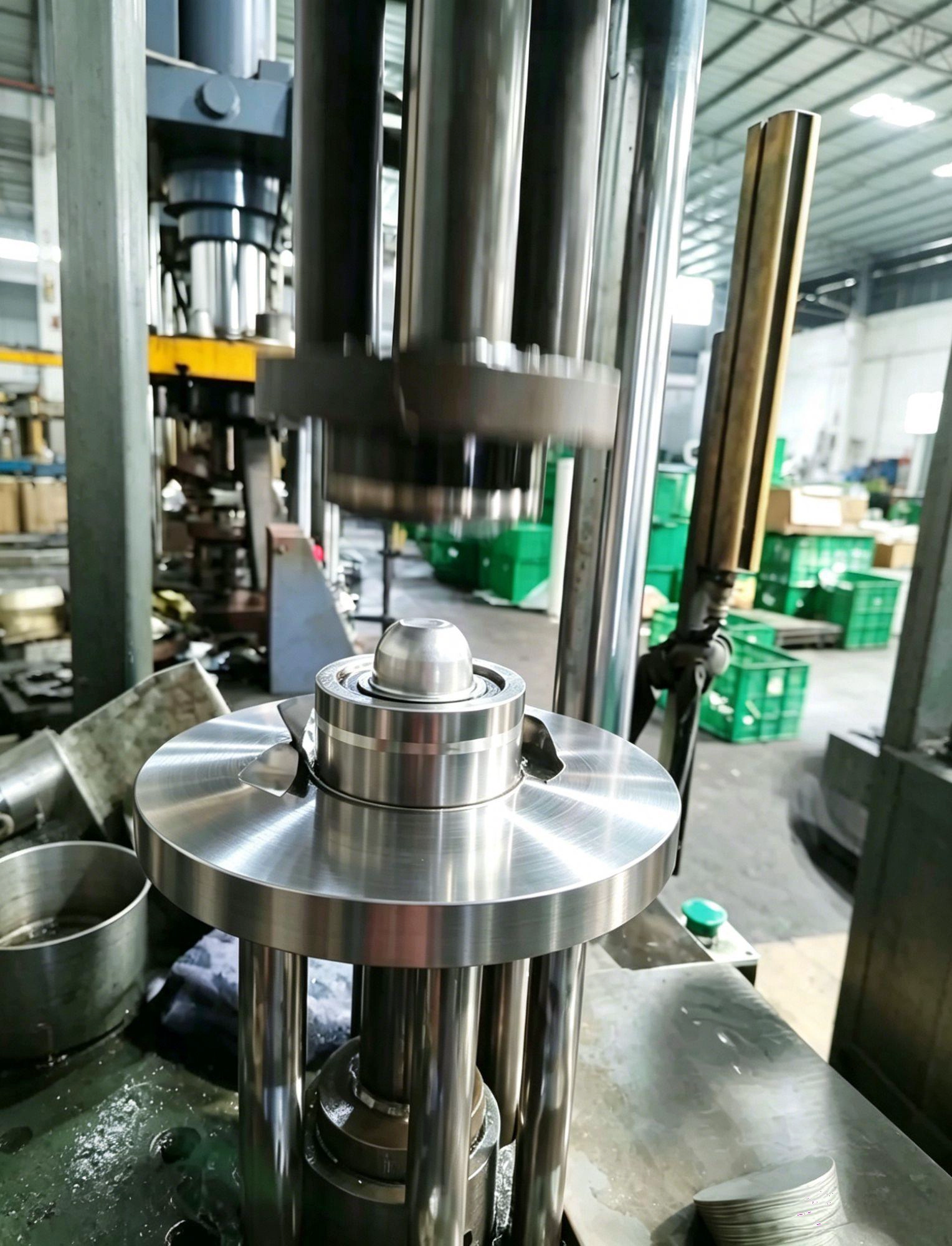
When a flat 304 stainless steel blank is deep-drawn into a tapered cone, the material undergoes non-uniform stress distribution across its cross-section. The inner wall is compressed; the outer wall is tensioned. When the punch retracts, the metal springs back. Because the springback force is not uniform across the cone's taper angle, the final internal diameter at any given height is unpredictable without highly controlled tooling.
A deviation of 0.3mm in internal diameter at the 1oz measurement line translates directly into a volume error. On a standard jigger with a 28mm internal diameter at the 1oz mark, a 0.3mm springback error produces approximately 1.8ml of volume deviation.
The Graduated Marking Problem
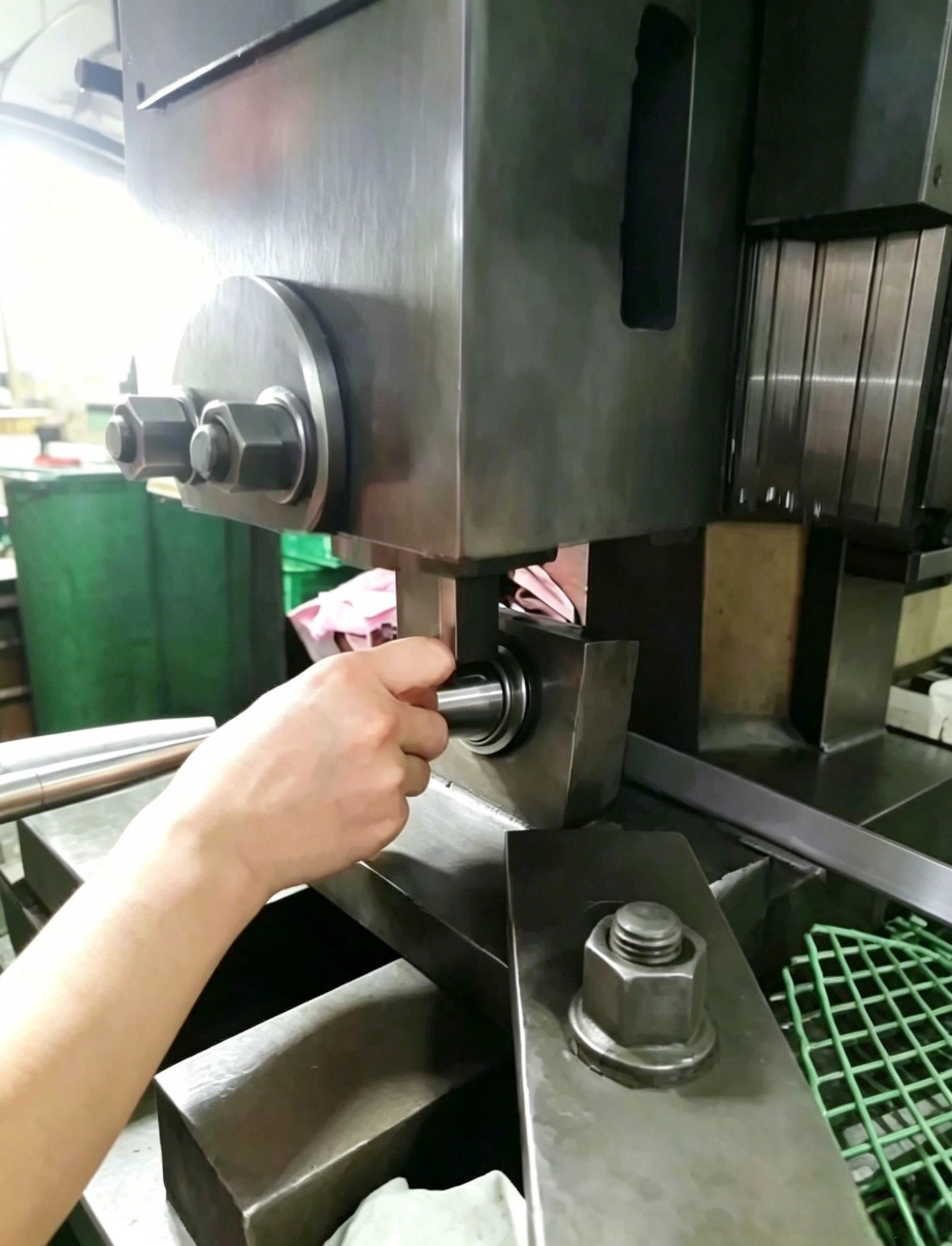
Traditional mechanical stamping of graduation lines requires applying lateral force to a curved, tapered surface. When cheap manufacturers use generic dies without proper internal support, that force creates localized deformation — micro-distortions in the sidewall geometry right where measurement depends on dimensional accuracy. The industry has tolerated this for consumer barware, but for premium on-trade programs, it fails brand standards.
Our Manufacturing Solution
Material Control: Rejecting Grade 201 Steel
We source food-grade 304 stainless steel (with 316L available for superior chloride resistance) in coil form with a guaranteed thickness uniformity of ±0.02mm. Before a single blank enters our press, incoming material is sampled using precision digital micrometers (±0.001mm resolution) at multiple points across the sheet.
Unlike budget factories, we outright reject the cheaper Grade 201 steel. While 201 steel looks identical when polished, it lacks the nickel content necessary to withstand repeated commercial dishwasher cycles, leading to micro-corrosion that eventually compromises both hygiene and dimensional stability over years of heavy bar use.
Precision Deep Drawing & Custom Stamping Mandrels
Mechanical stamping is the universally accepted standard for top-tier barware brands. However, achieving a strict ±0.5ml tolerance with stamping requires superior tooling.
We solved the deformation problem by developing custom-calibrated stamping mandrels. During the graduation marking process, our solid steel internal support mandrels perfectly match the drawn cone's exact inner geometry. When the pneumatic press stamps the 1oz or 2oz line from the outside, the supportive inner tooling acts as an anvil, preventing any sidewall micro-warping. This allows us to deliver the classic, durable stamped lines that bartenders prefer, with an engineering-grade ±0.5ml accuracy.
When Do We Use Laser Etching?
While precision stamping covers the vast majority of premium production, we also maintain in-house multi-axis laser etching capabilities. We recommend laser etching exclusively for clients who require highly complex, multi-line custom measurements (e.g., adding 1/4 oz, 1/3 oz, 3/4 oz, and bar spoon markings on a single unit) where investing in multiple custom mechanical stamping dies would be cost-prohibitive.
Premium Finishes & Global OEM Scalability
Once the baseline physical precision is locked in, we support premium brand aesthetics. We provide commercial-grade PVD coatings (Gold, Gunmetal Black, Copper) and mirror or brushed finishes. From custom retail-ready packaging to global freight logistics, we handle full OEM fulfillment for orders ranging from 500 to 50,000 units.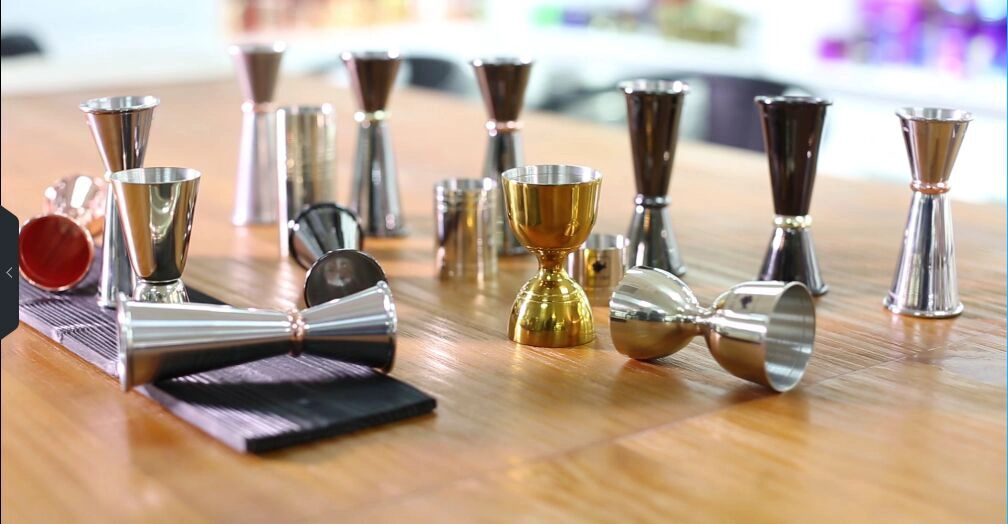
Precision Comparison: Generic Manufacturing vs. Our Process
| Manufacturing Dimension |
Generic Jigger Manufacturing |
Our Precision Engineering |
| Material Standard |
Often Grade 201 (prone to commercial wear) |
Strictly Grade 304/316L (NSF compliant) |
| Graduation Tooling |
Standard stamping without custom internal support |
Precision stamping with custom-calibrated support mandrels |
| Volume Tolerance |
±3–5ml (industry average) |
±0.5ml (verified by gravimetric methodology) |
Custom & Multiple Graduations
(e.g., 1/4oz, 1/2oz, 3/4oz) |
Highly restricted; each new line requires expensive new stamping dies |
Unlimited flexibility via in-house Multi-Axis Laser Etching (Premium Add-on) |
| QC Method |
Visual inspection / single-point volumetric fill |
Gravimetric batch sampling at 22°C using analytical balance |
Quality Control: The 0.5ml Guarantee
Precision Gravimetric Calibration Methodology
Visual QC — filling to a line and observing the meniscus — is not an acceptable method for ±0.5ml verification. The variability introduced by lighting angles and human reading position exceeds the tolerance being measured.
To guarantee the quality demanded by the world's top-tier cocktail equipment brands, our QC team employs a rigorous gravimetric calibration methodology based on established metrology principles (such as those outlined in ASTM E542):
- Environment control: Lab maintained at 22°C ±0.5°C. At this temperature, distilled water has a known density of 0.99777 g/ml (according to standard reference tables).
- Equipment: Analytical digital balances calibrated to ±0.01g.
- Procedure: The jigger is filled to the graduation line. The water mass is recorded. Volume is calculated precisely (Mass ÷ Density).
- Sampling plan: AQL 1.0 per ANSI/ASQ Z1.4. For a 5,000-unit order, a sample of 200 units is tested. Any unit exceeding ±0.5ml flags the batch.
For the US brand referenced in this case study, the first production run of 3,000 units under this protocol returned a defect rate of just 0.3% (9 units flagged and replaced). Their previous supplier's run had failed at 23%.
Conclusion
The 0.5ml precision challenge in stainless steel jigger manufacturing is not solved by tighter operator attention. It requires coordinated engineering decisions: upstream material control, precision-supported mechanical stamping, and gravimetric (not visual) QC.
As a dedicated manufacturer with in-house die engineering, we deliver 0.5ml tolerance custom stainless steel jiggers that meet the most rigorous standards in the global barware industry.
If your current supplier cannot produce a gravimetric calibration report for your last production run, that's exactly why your measurement inaccuracies exist. Contact our engineering team today for a technical brief, process audit documentation, and a tooling quote specific to your jigger profile. We provide sample units with full QC data before any production commitment.