










English English 简体中文 简体中文 Deutsche Deutsche français français русский русский Español Español português português Ελληνικά Ελληνικά Italian Italian 한국어 한국어 Nederlands Nederlands
ShenZhen E-BON Industrial Co..Ltd
-Professional manufacturer for the stainless steel products
Do Stainless Steel Wine Glasses Affect the Taste of Wine?

Home > News > Industry News  > Do Stainless Steel Wine Glasses Affect the Taste of Wine?

News

Do Stainless Steel Wine Glasses Affect the Taste of Wine?

Do Stainless Steel Wine Glasses Affect the Taste of Wine?

2026-07-16 09:54:41

A practical explanation of why wine may seem different in stainless steel, how to identify a real off-flavor, and when steel or glass is the better choice.

What Is a Jigger? Sizes, Measurements, and How to Use One

What Is a Jigger? Sizes, Measurements, and How to Use One

2026-07-15 17:28:19

This guide explains what a jigger is, why its capacity varies, and how to read common oz and ml markings. It also shows how to use and check the tool, compare major styles, and avoid treating 25/50 ml, 30/60 ml, and 1/2 oz as identical.

How to Design Custom Barware for Your Brand: A Practical Guide

How to Design Custom Barware for Your Brand: A Practical Guide

2026-07-14 12:08:12

This guide helps brand owners, hospitality buyers, importers, and distributors turn a barware concept into a workable product. It explains how use, material construction, finish, logo placement, functional details, sampling, testing, and packaging should be considered together before bulk production.

Which Logo Method Actually Works Best for Custom Barware?

Which Logo Method Actually Works Best for Custom Barware?

2026-07-13 11:57:06

In custom logo barware production, a logo failure usually begins before printing. The artwork may have been approved without checking the curve of the cup. The ink may have been selected without confirming the coating. A laser setting may have produced a permanent mark, but not the color or contrast the buyer expected.

Custom Bar Supplies Manufacturer Checklist for Bulk Buyers

Custom Bar Supplies Manufacturer Checklist for Bulk Buyers

2026-06-27 16:54:26

This article explains how bulk buyers can choose a custom bar supplies manufacturer for stainless steel barware projects. It covers which bar supplies are suitable for factory production, how to prepare a clear RFQ, what to confirm before comparing quotes, how to record sample approval details, and which inspection points matter before bulk production. The guide is designed for distributors, importers, restaurant groups, and private label buyers who need consistent specifications, logo customization, packaging control, and repeatable manufacturing.

Private Label Hip Flask Sourcing Guide: Materials, Finishes, Packaging and MOQ

Private Label Hip Flask Sourcing Guide: Materials, Finishes, Packaging and MOQ

2026-06-27 09:55:59

This guide helps wholesale buyers, importers, gift companies, and private label brands source stainless steel hip flasks more clearly. It explains what to check before ordering, including material, wall thickness, surface finish, logo customization, packaging, MOQ, sample approval, quote comparison, and bulk inspection.

Jigger Buying Guide for Bars, Restaurants, and Private Labels

Jigger Buying Guide for Bars, Restaurants, and Private Labels

2026-06-25 14:57:14

This guide explains how bars, restaurants, distributors, and private label brands can source the right jigger by balancing target price, wall thickness, quality control, customization, sampling, and bulk production requirements.

Stainless Steel Cutting Board: A Complete Sourcing Guide for Wholesale Buyers

Stainless Steel Cutting Board: A Complete Sourcing Guide for Wholesale Buyers

2026-06-17 17:04:15

A sourcing guide for B2B buyers evaluating stainless steel cutting board suppliers — covering 304 vs. 201 grade verification, construction tolerances that affect durability, realistic hygiene claims versus marketing exaggeration, and the production details that actually matter for bulk orders: sample lead time, MOQ, and how to move from inquiry to a confirmed quote.

Custom Wine Tumblers Manufacturing Guide: Finishes, Branding & OEM Production

Custom Wine Tumblers Manufacturing Guide: Finishes, Branding & OEM Production

2026-06-11 10:32:29

Explore how custom stainless steel wine tumblers are manufactured, customized, and branded. Learn about vacuum insulation, surface finishing options, logo decoration methods, packaging solutions, and real OEM project examples for private label drinkware brands.

How We Guarantee ±0.5ml Precision in Stainless Steel Jiggers Using Advanced Stamping Tooling

How We Guarantee ±0.5ml Precision in Stainless Steel Jiggers Using Advanced Stamping Tooling

2026-06-01 14:31:40

This B2B engineering case study reveals how we solved critical measurement inaccuracies for a premium US barware brand. By replacing traditional mechanical stamping with adaptive multi-axis laser etching and implementing ASTM E542 gravimetric calibration, our facility manufactures custom stainless steel jiggers with a guaranteed ±0.5ml tolerance. Discover the exact manufacturing processes that protect premium brands from liquor waste and recipe inconsistency.

Contact us

Add: 1006-1008, Huatong Building, Sungang East Road, Luohu District, Shenzhen City,China Tel: +86-755-33221366  +86-755-33221388  +86-755-33221382  +8...

Do Stainless Steel Wine Glasses Affect the Taste of Wine?

2026-07-16 09:54:41

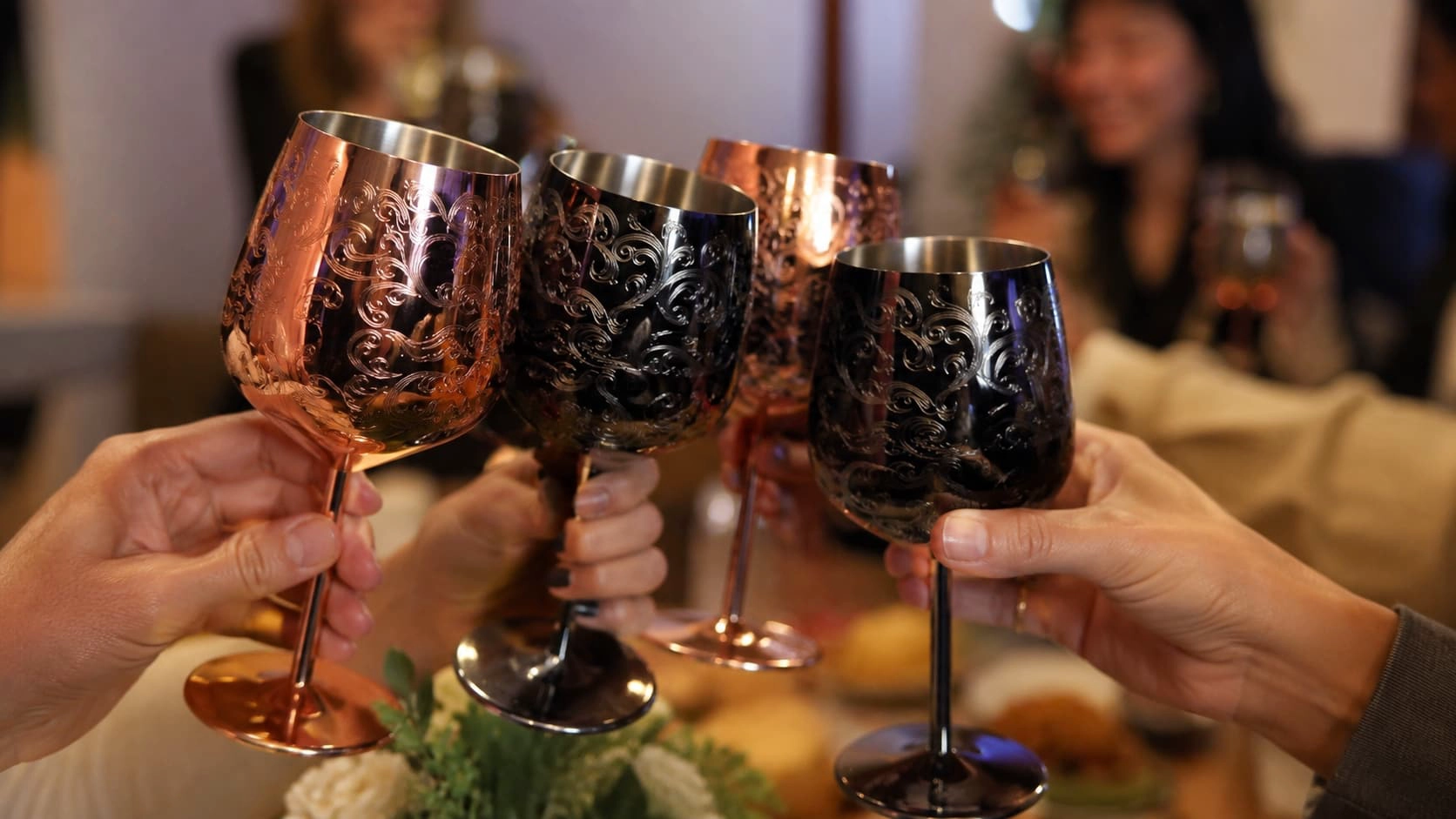
                  Premium etched stainless steel wine glasses raised for a toast at a dinner party
 

Quick answer: If you are asking, “do stainless steel wine glasses affect the taste of wine,” separate the wine itself from your perception of it. Suitable stainless steel normally does not chemically alter wine during a normal pour. Shape, rim, temperature, opacity, residue, and surface condition can still change what you perceive. A metallic or soapy note should be investigated, not dismissed as imagination.

Does Stainless Steel Chemically Change Wine?

Stainless steel is already used throughout winemaking, including tanks, pipes, pumps, and fittings. The International Organisation of Vine and Wine states that wine-contact materials should be inert and food-contact compliant, and its transport guidance identifies polished AISI 304 or 316 stainless steel for relevant equipment.

That does not mean every metal cup is automatically suitable. Material grade, inner-surface finish, manufacturing residue, corrosion, and condition all matter. It does mean that stainless steel itself is not foreign to wine. During the short contact time of normal drinking, suitable stainless steel should not make a sound wine chemically “metallic.”

Why Can the Same Wine Taste Different in a Metal Glass?

1. Aroma reaches your nose differently

Much of what we call flavor comes from aroma. Bowl width, taper, fill level, and opening size influence how volatile aromas collect and reach the nose. A controlled study involving 181 participants found that glass shape influenced the perceived odor of red and white wine.

2. You cannot see the wine

An opaque cup removes color, clarity, and the visual movement of the wine. That can be useful in blind tasting, but it also removes cues that normally prepare the brain for what is about to be tasted. Research on opaque and transparent wine glasses shows that visual information and expectation participate in sensory judgment.

This is one reason a familiar wine may seem less fruity, darker, lighter, or simply unfamiliar in stainless steel even when the liquid has not been damaged. For casual drinking this may not matter. For evaluating color, clarity, maturity, or faults, transparency remains useful.

3. Rim, weight, and surface feel change the sip

A thin rim usually directs attention toward the wine. A thick rolled rim is more noticeable on the lips and may change flow. The weight and cool touch of metal also set expectations before the wine reaches the mouth. A broad review of wine psychology and glassware research found that vessel effects depend partly on whether drinkers can see and handle the glass, not only on the liquid delivered from it.

4. Temperature behavior depends on construction

It is too simple to say that all metal glasses make wine warmer or colder. A single-wall stainless cup conducts heat readily, so hand temperature and ambient conditions can be felt quickly. A double-wall cup slows heat transfer and may hold a serving temperature longer. Glass thickness, room temperature, pour size, and how long the drink sits also matter.

If one sample is colder than another, flavor and aroma will not present in the same way. Before blaming the material, compare the same wine at the same starting temperature, fill level, and waiting time.

Why Does Wine Sometimes Taste Metallic in Stainless Steel?

A persistent off-note is a useful warning signal, but it does not automatically prove that the base metal is reacting with the wine. Start with the most common points of contact:
  • Detergent or rinse residue: Fragrance, surfactant, or hard-water deposits can appear as a chemical, bitter, or metallic impression.
  • Manufacturing residue: A new cup should be thoroughly washed before its first use to remove polishing compound, dust, or handling residue.
  • Retained odor: Rough seams, grooves, lids, silicone seals, or poorly cleaned areas can hold previous drink or cleaning odors.
  • Damaged inner surface: Pitting, rust-colored spots, exposed base material, or an unknown interior coating requires closer inspection. Do not keep using a visibly damaged cup for acidic beverages until the construction is confirmed.
  • Temperature mismatch: A colder or warmer pour can suppress fruit, emphasize acidity, or change aroma release enough to be described as metallic.
  • The wine itself: Reduction, oxidation, storage conditions, and food pairing can produce unusual impressions that happen to be noticed after changing cups.

A Five-Minute Test Before You Blame the Glass

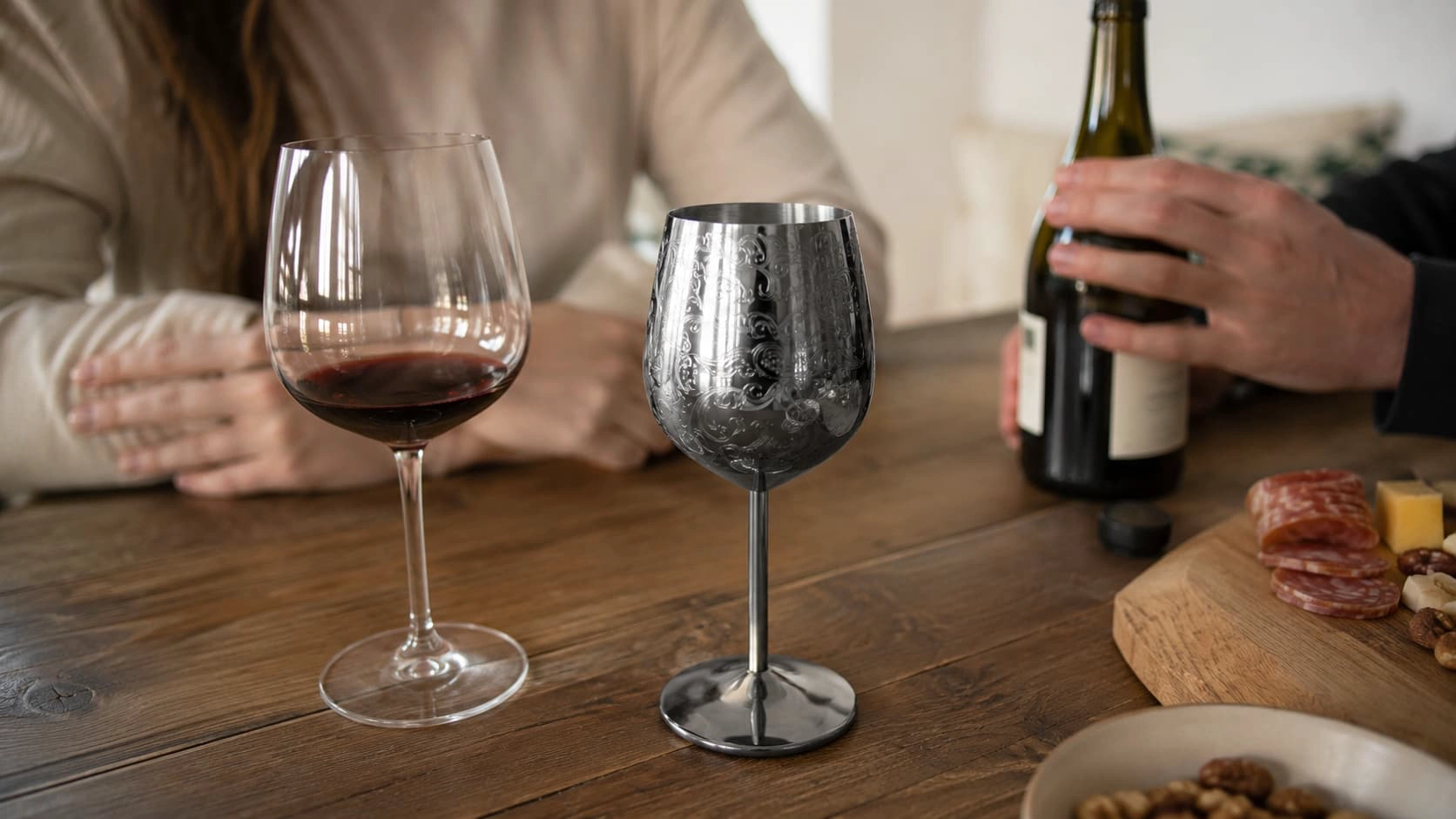
Etched stainless steel wine glass beside a traditional glass wine glass with red wine at a dinner table
 

  1. Clean and rinse the cup again. Use an unscented cleaner, rinse thoroughly, and let it air dry. Remove and clean any lid or seal separately.
  2. Test plain water first. Pour the same water into a clean glass and the stainless cup. Smell both before tasting. If the difference appears in water, inspect the cup rather than the wine.
  3. Split one wine between two vessels. Use equal pours at the same temperature. Do not compare different bottles or servings opened at different times.
  4. Smell, then sip. Compare aroma intensity before comparing flavor. If aroma changes but the finish does not, bowl shape or opening size may be the main cause.
  5. Inspect the contact surface. Check the interior, rim, welds, seams, coating boundaries, and removable parts. Stop the test if you find corrosion or a damaged food-contact surface.

This simple comparison is more useful than asking whether all stainless steel glasses affect all wines. It isolates the vessel while keeping the wine and serving conditions consistent.

Stainless Steel or Glass: Which Should You Use?

Use case Better starting choice Reason
Analytical tasting or wine education Clear glass Shows color and clarity and minimizes unfamiliar vessel cues.
Outdoor dining, pools, camping, or events Stainless steel Durable and break-resistant where glass may be impractical or restricted.
Long, slow tasting of delicate wine Thin-rim glass Familiar bowl geometry and visibility support detailed evaluation.
Branded hospitality, gifts, or reusable event service Stainless steel, after sample review Combines durability and decoration, but rim, interior, bowl, and finish should be approved.
Storing leftover wine A suitable sealed storage container A drinking cup is not a substitute for controlled wine storage.

Stainless steel is not trying to replace every crystal tasting glass. Its value is strongest where break resistance, repeat use, transport, or branding matters. For more detail on those environments, see our guide to stainless steel wine glasses for outdoor and commercial use.

What Buyers Should Check Before Approving a Stainless Wine Glass

When a buyer asks whether a gold, copper-tone, or black wine glass will make wine taste metallic, the color is not the first question. The first question is what material and finish actually touch the wine. An exterior decorative finish and a stainless interior are a different construction from a coated interior.

Before approval, confirm the declared stainless grade, inner-surface treatment, rim profile, bowl opening, single-wall or double-wall construction, and cleaning instructions. If a decorative process is used, the specification should clearly identify where it is applied. Then test a production-representative sample with water and wine instead of judging from a rendering alone.

For hospitality or retail programs, the sample should also be handled as it will be in real service. Hold it for several minutes, use the expected pour volume, clean it with the intended method, and check whether logos or exterior finishes change the grip or lip contact. Our stainless steel wine glass page shows one product direction, but the final decision should still follow the target use and approved sample.

Frequently Asked Questions

Is 304 stainless steel suitable for wine glasses?

304 stainless steel is widely used for food-contact products and wine equipment. Suitability still depends on the finished product, including the actual material declaration, interior condition, manufacturing quality, and intended use.

Does stainless steel affect red and white wine differently?

The material does not create a universal red-versus-white effect. Temperature, aroma intensity, tannin, acidity, bowl shape, and serving time can make a vessel difference more noticeable in one wine than another.

Can wine be left in a stainless steel glass overnight?

A normal serving period is different from storage. For leftover wine, use a clean, sealable container designed to limit oxygen exposure and follow the wine’s storage needs rather than leaving it in an open drinking cup.

Why does a new stainless cup smell or taste strange?

Polishing compound, packaging odor, dust, detergent, or residue on removable parts may be responsible. Wash and rinse every contact surface before first use. If the odor remains or the interior appears damaged, stop using it and ask the supplier to confirm the construction.

Is glass always better for wine?

Glass is usually the better tool for formal tasting and visual assessment. Stainless steel can be the better service choice when break resistance, portability, or reusable branded presentation matters. The right answer depends on the job the glass must do.

Choose the Vessel for the Experience You Need

A good stainless steel wine glass should not ask the drinker to tolerate a metallic flavor. Its purpose is to provide a durable alternative while keeping the wine-contact surface clean, smooth, and appropriate. The experience may still differ from glass, especially in aroma, temperature, visibility, and rim feel, but different does not automatically mean defective.

If you are selecting stainless wine glasses for retail, hospitality, outdoor service, or a branded program, send E-BON your intended use, preferred shape, finish, and cleaning method. We can review the contact surface and specification, then prepare a sample plan so you can evaluate the actual drinking experience before production.