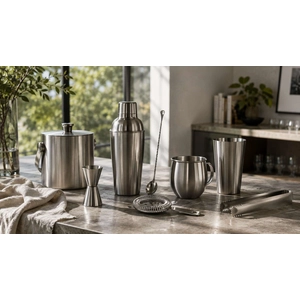



A practical framework for turning multiple shakers, jiggers, strainers, mugs and accessories into one recognizable barware collection through shared design anchors, controlled variation and range-level sample approval.
For most high-volume commercial bars, a tin-on-tin Boston shaker is the stronger primary tool. This article compares service speed, cleaning, straining, menu fit and bulk-order checks, while showing where a Cobbler still makes operational sense.
A practical method for mapping a commercial bar station around the drink-production path, fixed tool positions, clean-to-dirty movement, shared-station ownership and opening resets. It also helps operators and buyers distinguish a true tool shortage from a reset, cleaning-return or fixed-layout problem before changing the barware order.
A commercial buying guide comparing Hawthorne, Julep and fine mesh cocktail strainers by drink method, filtration role, pouring speed, vessel fit and cleaning workload. It gives bars a clear way to choose a practical station combination.
A station-by-station buying plan for commercial bars deciding how many shakers, jiggers, strainers, mixing tools and backup units to order. It explains how peak workflow, menu mix, washing conditions, layout and tool loss change the final quantity.
A practical guide for private-label brands, importers and bulk buyers approving barware before mass production. It covers the PPS checklist, water-weight capacity checks, change control, third-party testing and the handoff to production sampling inspection.
A practical explanation of why wine may seem different in stainless steel, how to identify a real off-flavor, and when steel or glass is the better choice.
This guide explains what a jigger is, why its capacity varies, and how to read common oz and ml markings. It also shows how to use and check the tool, compare major styles, and avoid treating 25/50 ml, 30/60 ml, and 1/2 oz as identical.
This guide helps brand owners, hospitality buyers, importers, and distributors turn a barware concept into a workable product. It explains how use, material construction, finish, logo placement, functional details, sampling, testing, and packaging should be considered together before bulk production.
In custom logo barware production, a logo failure usually begins before printing. The artwork may have been approved without checking the curve of the cup. The ink may have been selected without confirming the coating. A laser setting may have produced a permanent mark, but not the color or contrast the buyer expected.
304 stainless steel and 201 stainless steel method of differentiation!
2017-06-14 10:18:57
When it comes to 304 stainless steel and 201 stainless steel, we certainly do not unfamiliar, but in the eyes of many consumers, the difference with the naked eye is not good or bad business judgment directly, shoddy, with 201 stainless steel as 304 stainless steel, not only the loss of customers, more serious may also occur in danger. So we introduce the two kinds of stainless steel features to distinguish between 304 stainless steel and 201 stainless steel.
304 stainless steel features: 304 stainless steel is a common stainless steel materials, processing performance, high toughness, widely used in all walks of life. The most important elements in 304 stainless steel are Ni and Cr. 201 stainless steel as a typical representative of the 200 lines, 18% of the chromium content and low nickel content is not up to the balance and the formation of ferrite, therefore, 200 series stainless steel chromium content reduced to 13.5% ~ 15%, and in some cases reduced to 13% ~ 14%, its corrosion resistance is far can not be compared with the 304.
304 stainless steel and 201 stainless steel method of differentiation Therefore, compared with the 304 stainless steel, the content of Ni Cr stainless steel 201 are less than 304, from the point of view of colour, 201 stainless steel containing manganese, the color will be more than 304 to 304 dark, bright, but it is not easy to distinguish between the naked eye. Because of the difference in nickel content, the corrosion resistance and acid resistance of 201 stainless steel are not as good as 304. And because the carbon content of 201 is higher than 304, so 201 to 304 to hard brittle, with a little steel, relatively easy to crack, and 304 of the toughness is better. If a sharp knife is used to mark the surface of the 201 stainless steel, there will be a marked scratch, and 304 of the scratches will not be particularly evident. Because 201 contains manganese, it will not rust if it is wet and salty in the air for 304 years. E-BON, china Stainless steel factory, provides the high quality 304 stainless steel products. Contact us, click here: Stainless Steel Food Grip Serving Tongs.